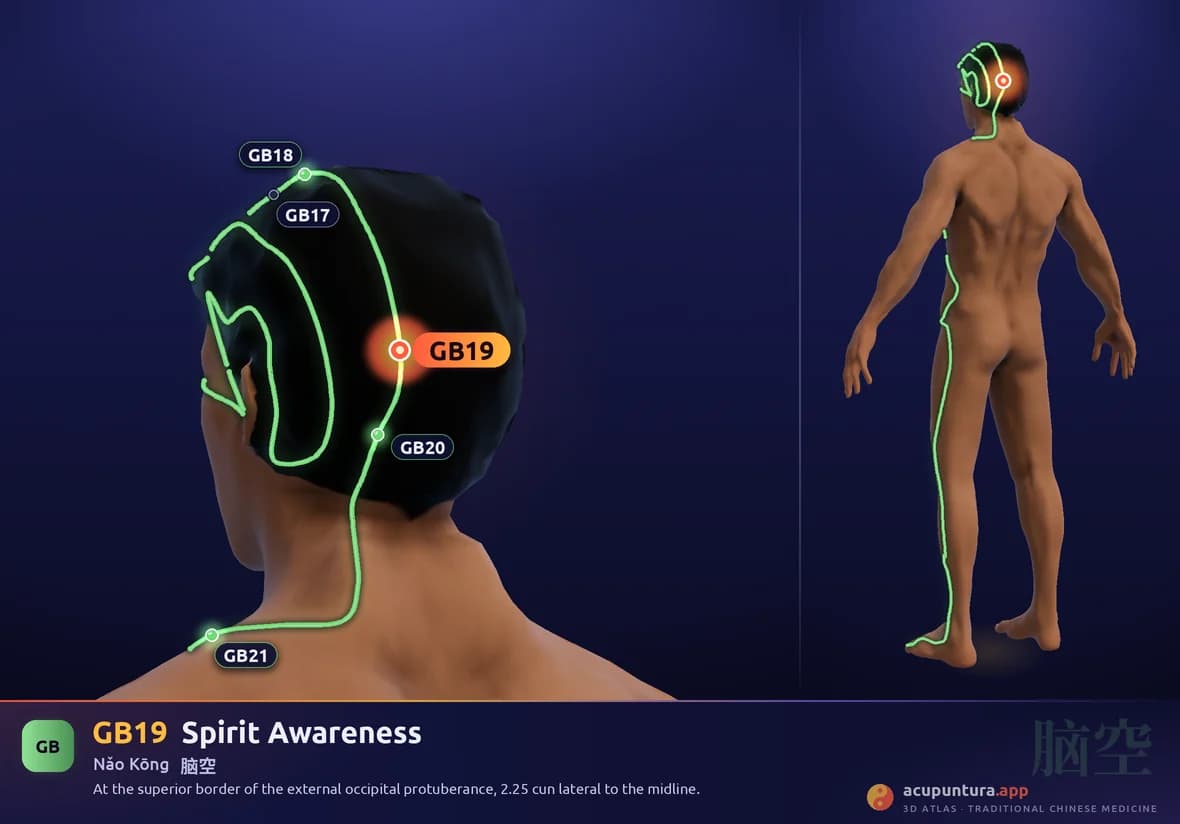
Gallbladder Channel
Spirit Awareness
脑空Nǎo KōngAnatomical location
At the superior border of the external occipital protuberance, 2.25 cun lateral to the midline.
Main function
Eliminates Wind, calms the Shen.
Therapeutic indications
- Headache
- vertigo
- insomnia
- Neck stiffness
- Tinnitus
- Epilepsy
- Palpitations
Name and classical tradition
Naokong, 脑空, is the "Brain Hollow": 脑, brain, and 空, empty, a cavity. The point lies in the occipital region, next to a bony depression that can be felt under the fingers, and the name seems to allude to that palpable fossa over the brain.
Its alternate name, 颞颥, is a classical anatomical term: the two characters designate the temporal region of the skull, and the Lingshu (Spiritual Pivot) uses them in that sense. The reference works explain the alias by the point's proximity to the temporal bone. Whether the use of 颞颥 as a name for this point has classical support or is a later association by proximity could not be established.
Secondary sources trace Naokong to the Zhenjiu Jiayi Jing (Systematic Classic of Acupuncture and Moxibustion). Like other points in this part of the channel, it is a crossing point of the Foot Shaoyang with the Yang Wei Mai, and it is the last one before reaching the nape of the neck and GB20.
Other names
- 顳顬Jiayi Jing