Gallbladder Channel
Shoulder Well
肩井Jiān JǐngContraindicated during pregnancy
Strong downward movement of Qi; the shoulder pulls on the uterine axis. Prohibited throughout pregnancy.
Anatomical location
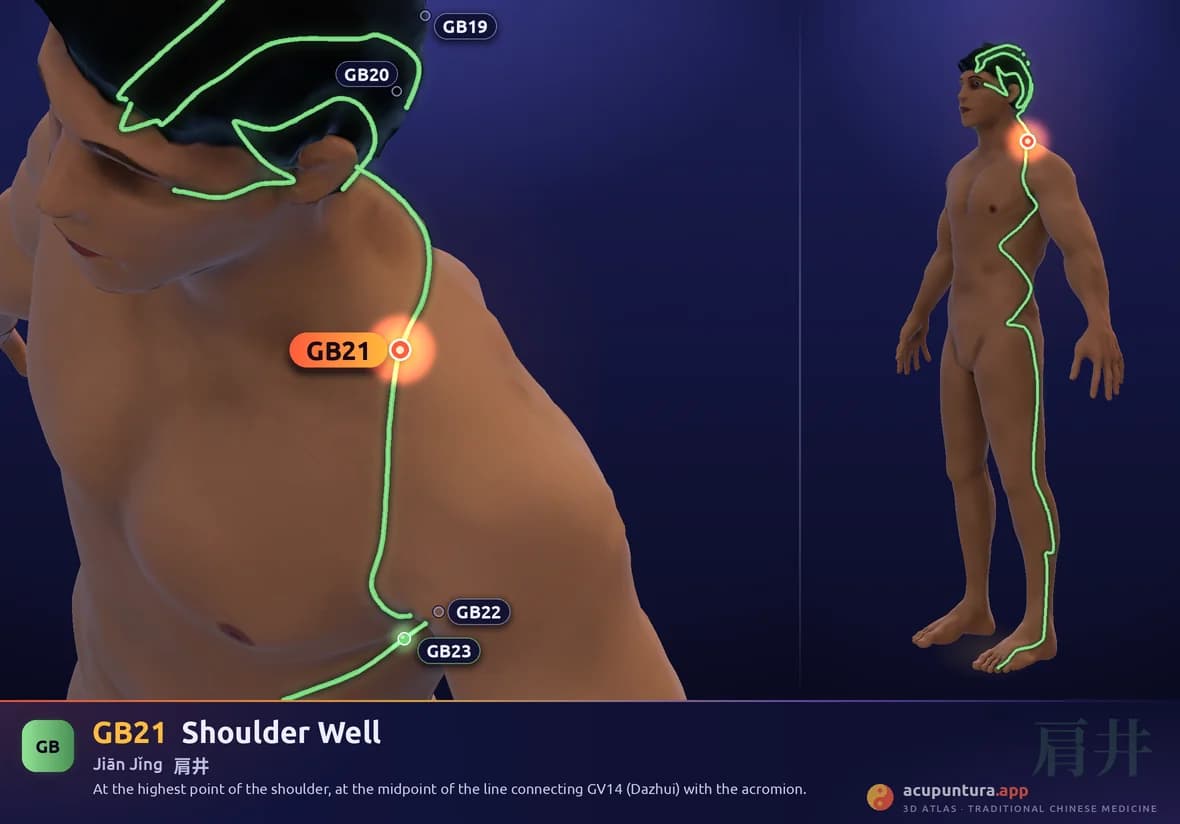
At the highest point of the shoulder, at the midpoint of the line connecting GV14 (Dazhui) with the acromion.
Main function
Regulates Qi and Blood, relieves shoulder pain.
- Crossing point with the Triple Energizer and Yang Wei Mai
Therapeutic indications
- Shoulder pain
- stiff neck
- mastitis
- shoulder and neck pain and stiffness
- trapezius contracture
- insufficient lactation
- scrofula
- hypertension
- upper back pain
- difficult labor at term
- tension headache
Name and classical tradition
Jianjing, 肩井, is the "Shoulder Well." 肩 is the shoulder, 井 the well: the point lies in the deep depression of the trapezius, at the top of the shoulder, and the image of the mouth of a well is easy to recognize on palpation.
It was not always called this. The Suwen (Basic Questions), in the Qi Xue Lun (气穴论) chapter, records it as 肩解. It was the Zhenjiu Jiayi Jing (Systematic Classic of Acupuncture and Moxibustion), in the third century, that fixed 肩井, and that name became the standard. The character 解 in the old name has been interpreted in two ways: as "joint," what separates and bends, which is the more anatomical reading, or as "to dissolve," referring to the point's capacity to break up stagnation. The second is a modern gloss without a citation. The reference works also give it the name 膊井, "Arm Well."
Jianjing is a point where many channels meet: the Hand Shaoyang, the Foot Shaoyang, the Foot Yangming, and the Yang Wei Mai.