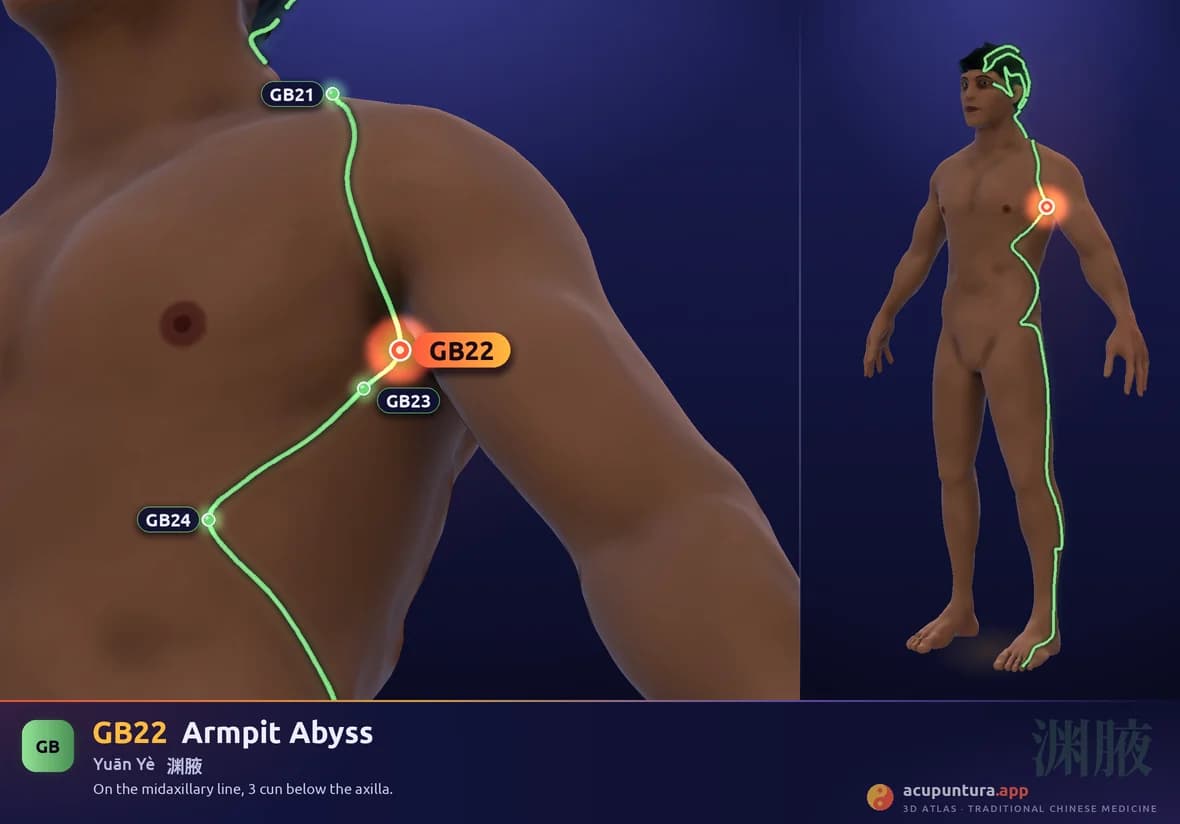
Gallbladder Channel
Armpit Abyss
渊腋Yuān YèAnatomical location
On the midaxillary line, 3 cun below the axilla.
Main function
Regulates Liver Qi, relieves chest pain.
Therapeutic indications
- Chest pain
- cough
- rib pain
- costal pain
- chest fullness
- axillary pain and swelling
- arm pain
Name and classical tradition
Yuanye, 渊腋, is the "Armpit Abyss": 渊, a deep pool, deep water, and 腋, armpit. The image describes the deep hollow beneath the arm, on the midaxillary line. It is a vivid name, and in this case it has unusually strong textual support for a point on the trunk.
The point appears in three places in the classical corpus. The Lingshu (Spiritual Pivot) names it in the Jing Mai (经脉) chapter. The Suwen (Basic Questions), in the Qi Fu Lun (气府论) chapter, mentions it among the places where the Qi of the Foot Shaoyang emerges, three cun below the axilla. And the Zhenjiu Jiayi Jing (Systematic Classic of Acupuncture and Moxibustion) includes it in a section with its own title, "腋胁下凡八穴第十八," the section on the eight points of the axilla and flank. All three mentions are well corroborated by independent sources, although the literal text of each has not been checked word for word.
The Jiayi Jing also gives it one of its most graphic warnings: "不可灸,灸之不幸生腫蝕馬刀,傷內潰者死"; no moxibustion is to be applied, and if it is, the misfortune is that a corrosive swelling erupts, and if it ulcerates internally, death follows. The reference works record two alternate names: 泉腋, which swaps the abyss for a spring, and 渊液, a homophone of the main name.