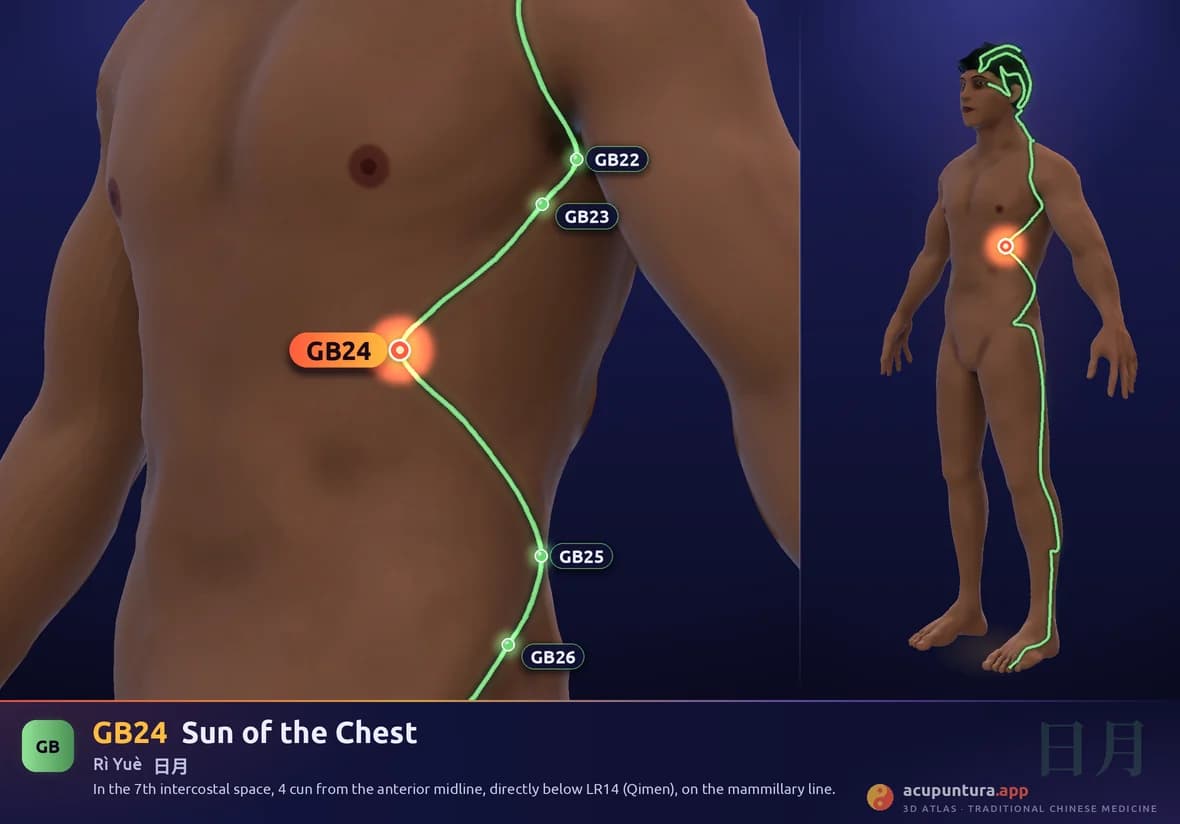
Gallbladder Channel
Sun of the Chest
日月Rì YuèAnatomical location
In the 7th intercostal space, 4 cun from the anterior midline, directly below LR14 (Qimen), on the mammillary line.
Main function
Regulates the Liver and Gallbladder, relieves pain.
- Front-Mu point of the Gallbladder
- Crossing point with the Spleen
Therapeutic indications
- Hypochondriac pain
- jaundice
- nausea
- costal pain
- cholecystitis
- vomiting
- acid reflux
- hiccups
- abdominal distension
- cholelithiasis and biliary colic
Name and classical tradition
Riyue, 日月, "Sun and Moon," is one of the most symbolically loaded names on the channel. The sun is yang and the moon is yin, and the usual interpretation applies the pair to the organ couple: the Gallbladder would be the sun, a yang Fu organ, and the Liver the moon, a yin Zang organ. The point, on the flank below the chest, is dedicated to that interior-exterior pair, which organ theory treats as a unit.
Riyue is the Front-Mu point (募穴) of the Gallbladder, the place on the anterior surface of the trunk where the Qi of the Fu organ concentrates, and it is also a crossing point of the Foot Taiyin and Shaoyang. Secondary sources consistently trace it to Wang Shuhe's Maijing (Pulse Classic), a third-century work, although the passage has not been verified literally.
It has a well-attested alternate name: 神光, "Spirit Light." Sun, moon, and light: the semantic field of the point is coherent from beginning to end.