GB25

Gallbladder Channel

Abdomen Capital

京门Jīng Mén

Anatomical location

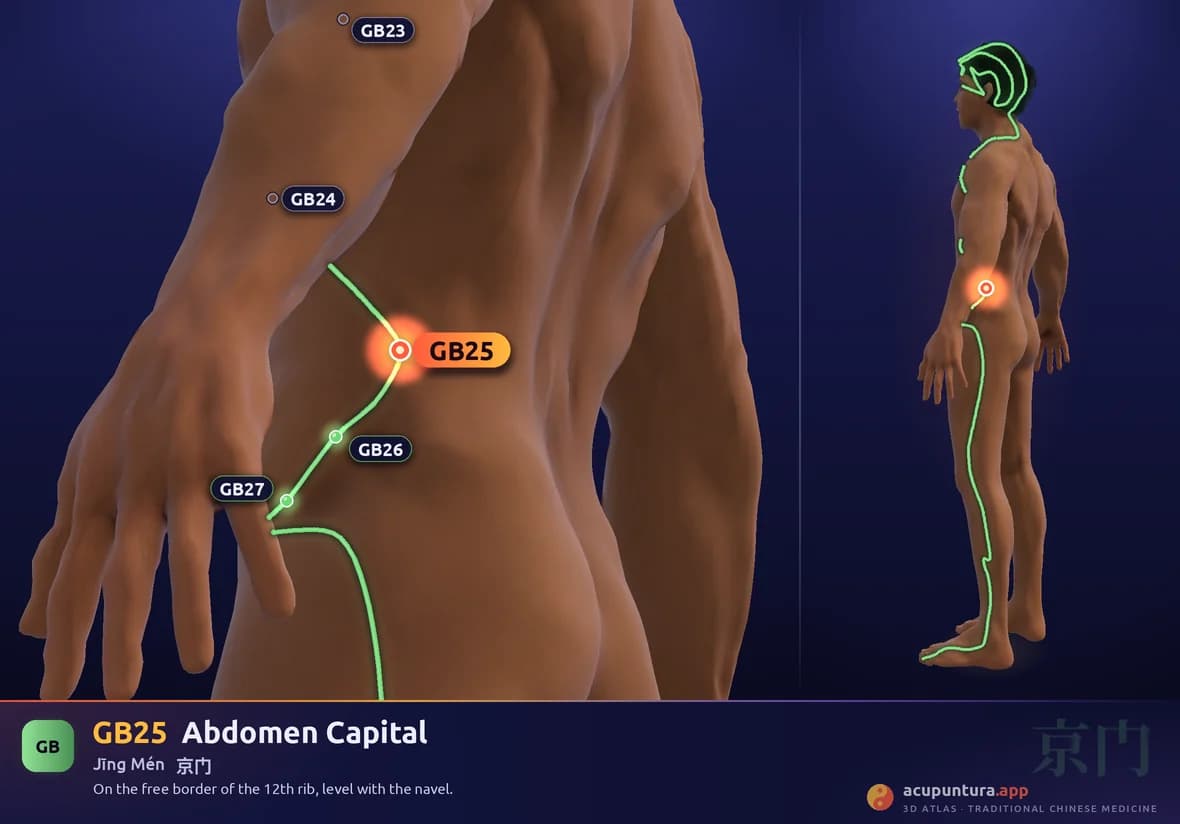
On the free border of the 12th rib, level with the navel.

Main function

Regulates the Kidney, relieves low back pain.

  • Front-Mu point of the Kidney

Therapeutic indications

  • Low back pain
  • edema
  • dysuria
  • lumbago
  • costal pain
  • abdominal distension
  • diarrhea
  • borborygmi

Name and classical tradition

Jingmen, 京门, is the "Capital Gate." 京 is the capital, the great city, and in its classical use also a great storehouse, an accumulation; 门 is the gate. Jingmen is the Front-Mu point (募穴) of the Kidney, and the reference works read the name from there: the gateway to the great reservoir of water, which is the Kidney. The reading is consistent with its use for regulating Body Fluids, although no classical commentary supports it.

Like its neighbor GB24, sources trace it to Wang Shuhe's Maijing (Pulse Classic), with no verified literal citation. It has two alternate names that stress Qi: 气府, "Qi Storehouse," and 气俞, "Qi Transport Point." It is a curious point on the Atlas map, because the Gallbladder channel houses here the alarm point of an organ that is not its own.

Other names

  • 氣府Jiayi Jing
  • 氣俞Jiayi Jing
Location of point GB25, Abdomen Capital
CC BY-ND 4.0 (opens in a new tab)
View point on the 3D modelGB25 on the anatomy
Needling techniquePerpendicular insertion 0.5-1 cun.
Depth0.5-1 cun
MoxibustionApplicable (5-10 minutes, indirect moxa)
PrecautionsAvoid deep needling to prevent injury to the kidney.

Basic formulas from the vademecum · 1

View the vademecum

Named functional sets from the school: here the point does not act on its own, but through the role it plays within the maneuver.

  • Tonify Kidney YinPregnancyReplenishes the Yin and the Essence: KI3 as the Yuan-Source point, KI7 as the tonification point (Metal, the mother), KI10 as the channel's own Water point, GB25 as the Front-Mu point of the Kidney, and CV4 as the root of the Yuan Qi.
Cover of the guide “Protocols for the 20 most common patterns”

Free guide · PDF

Protocols for the 20 patterns you see most in practice

Each pattern with its tongue, its pulse, the treatment principle and the points to tonify and disperse. Made for the treatment table, not the bookshelf.

Do you use GB25 with your patients?

In the Clinic you record it in the patient's file, next to the tongue, the pulse and the measurements, so at the next session you know exactly what you used. The Atlas is built in.

See the Clinic