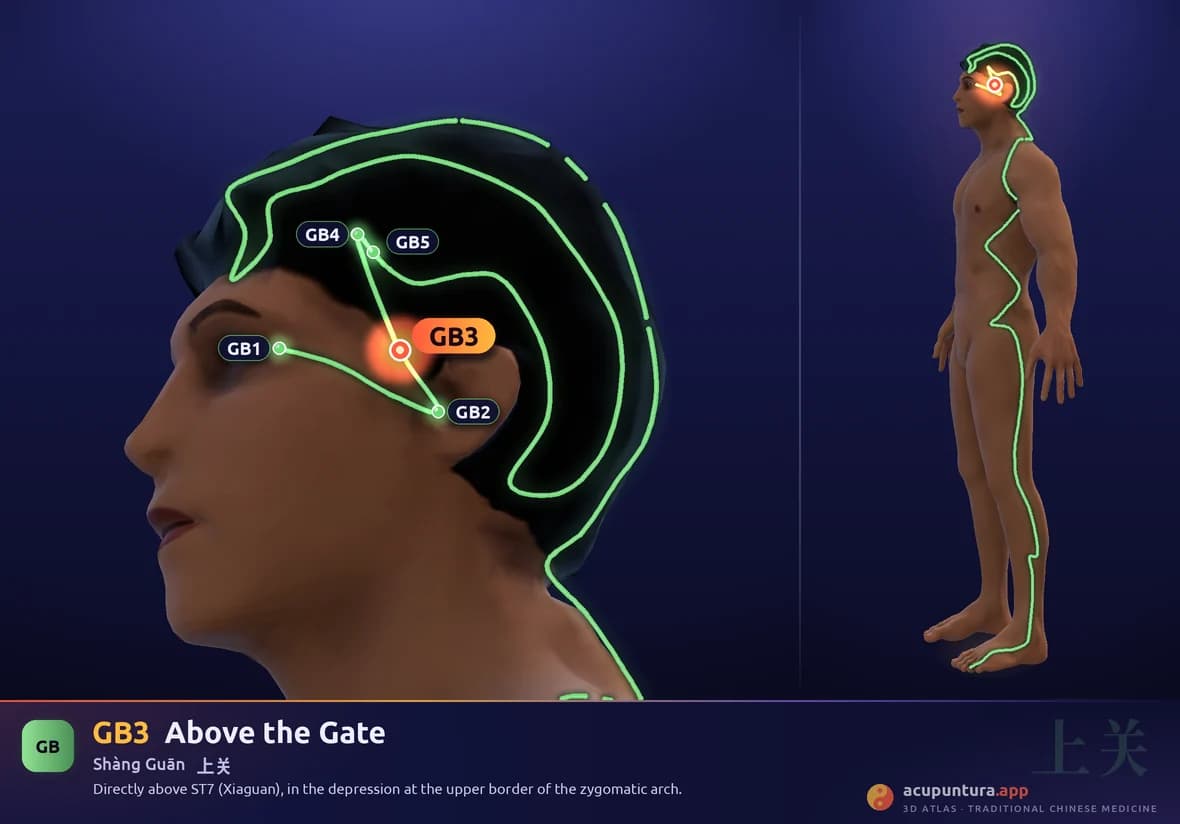
Gallbladder Channel
Above the Gate
上关Shàng GuānAnatomical location
Directly above ST7 (Xiaguan), in the depression at the upper border of the zygomatic arch.
Main function
Benefits the ears and teeth, expels Wind.
- Crossing point with the Stomach
Therapeutic indications
- Tinnitus
- toothache
- headache
- Deafness
- Facial paralysis
- Trismus
- Epilepsy
Name and classical tradition
Shangguan, 上关, is the "upper barrier." The 关 in the name refers to the temporomandibular joint, and 上 contrasts it with Xiaguan, ST7, the "lower barrier," which the Stomach channel places just below, on the same axis. The two names work as a pair and are best understood together: one above the zygomatic arch, the other below.
What is most interesting about the point is its old name. The Zhenjiu Jiayi Jing (Systematic Classic of Acupuncture and Moxibustion) also records it as 客主人, "the guest and the host," and the alias appears associated with the Lingshu (Spiritual Pivot) in its Jing Mai chapter. The explanation that several independent sources repeat starts from its status as a meeting point: here the hand and foot Shaoyang meet the foot Yangming. The Yangming, arriving from outside, would be the guest (客); the Shaoyang, master of the channel, the host (主). The reading is consistent with the function of the point, although no classical commentary spells it out in those terms.
The Jiayi Jing entry brings the two names together, «上關,一名客主人», presents the point as the meeting of the hand Shaoyang and the foot Yangming, and warns: «刺太深令人耳無聞», if it is needled too deeply, the person is left deaf. Over time, 上關 displaced the alias. The image of the host receiving a guest is, all the same, one of the most graphic ways classical nomenclature has of describing a crossing of channels.
Other names
- 客主人Jiayi Jing