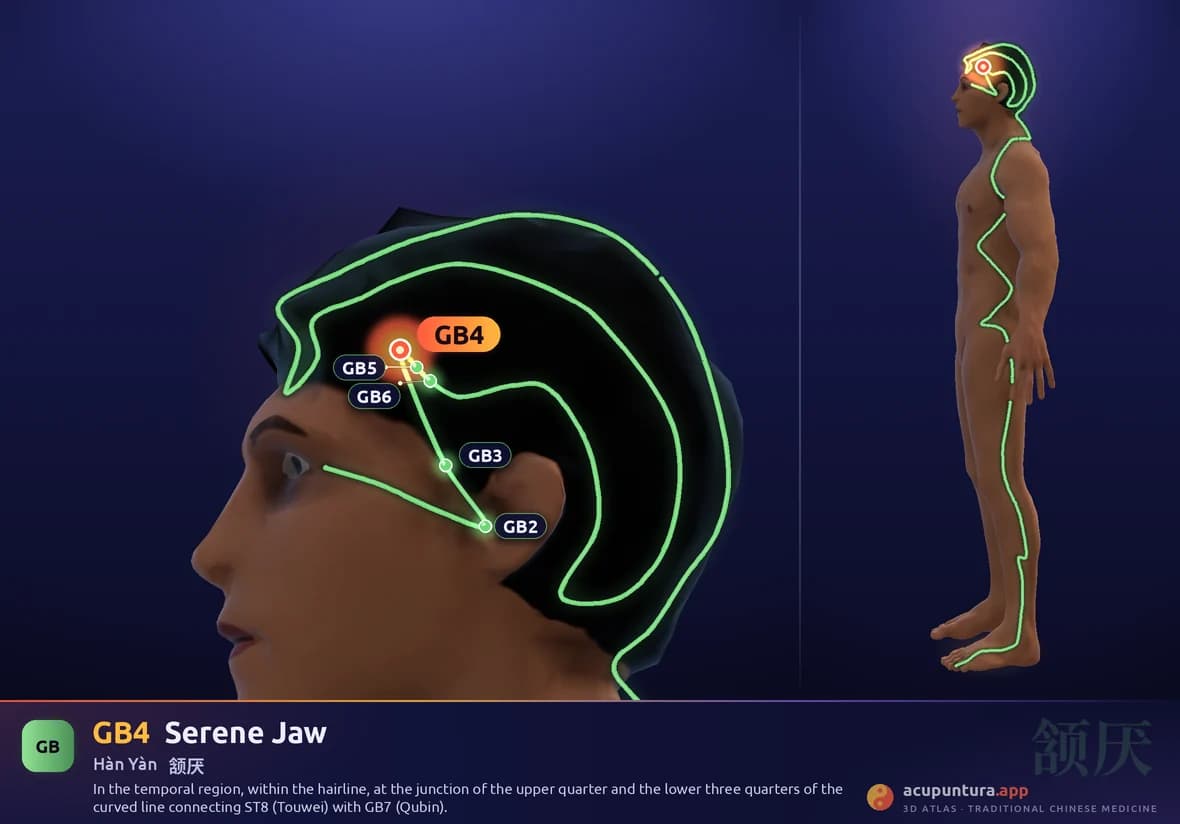
Gallbladder Channel
Serene Jaw
颔厌Hàn YànAnatomical location
In the temporal region, within the hairline, at the junction of the upper quarter and the lower three quarters of the curved line connecting ST8 (Touwei) with GB7 (Qubin).
Main function
Expels Wind-Heat, relieves headache and toothache.
- Crossing point with the Triple Energizer and Stomach
Therapeutic indications
- Headache
- vertigo
- tinnitus
- toothache
- eye pain
- Migraine
- Epilepsy
- Neck stiffness
Name and classical tradition
Hanyan, 颔厌, is a name that can be read in more than one way, and none of the readings has support in a classical commentary. 颔 is the jaw or the cheek area. 厌 admits two meanings. In the first reading it means "to reach the limit," "to stop": the point would mark the place on the temple where the pull of the muscle stops when chewing. In the second, 厌 equals "to join," "to coincide," and the name would describe how, when chewing, the jaw and the temple move together, as if meeting at this point.
Both glosses are modern and should be treated as hypotheses. What you can feel on palpation is the relationship with chewing: the point lies on the temple, within the hairline, over the temporalis muscle that moves when you clench your teeth.
The reference works trace it to the Zhenjiu Jiayi Jing (Systematic Classic of Acupuncture and Moxibustion) and consider it a meeting point of the hand and foot Shaoyang with the foot Yangming. It opens the series of temple points on the channel, which continues with GB5 and GB6.