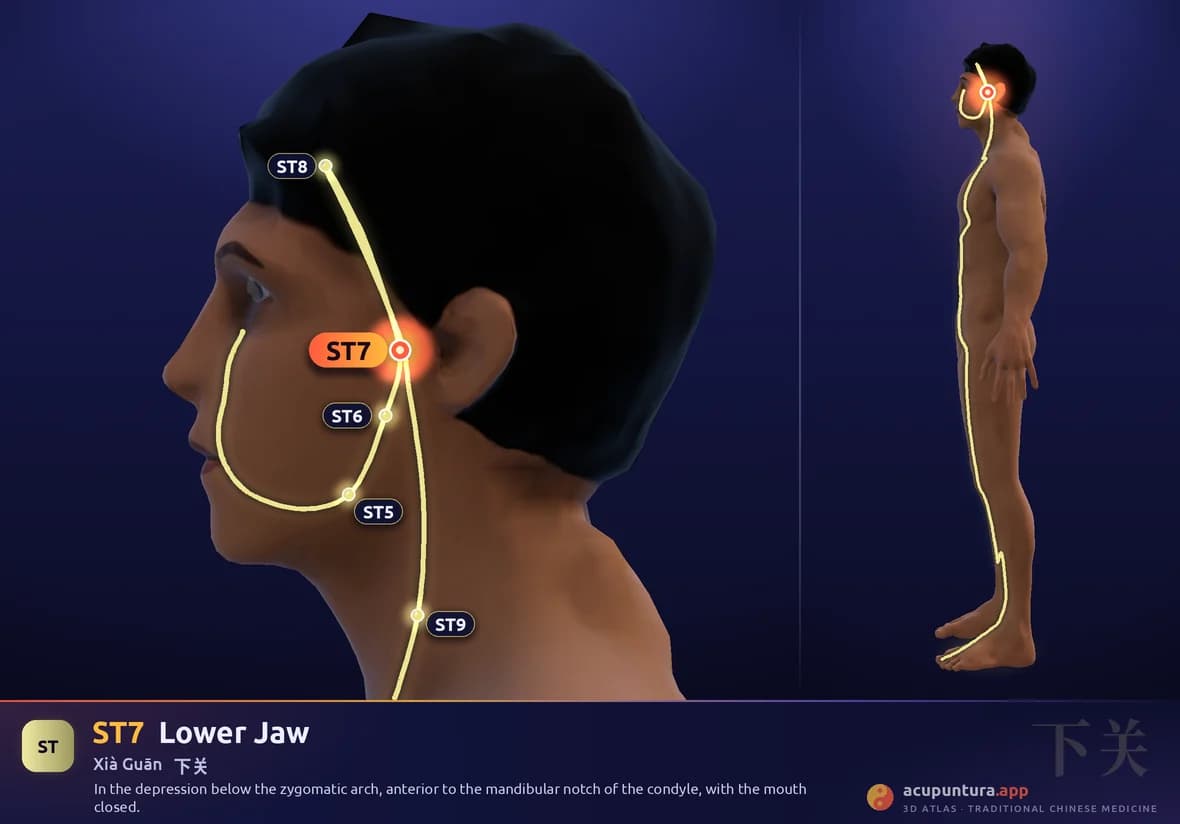
Stomach Channel
Lower Jaw
下关Xià GuānAnatomical location
In the depression below the zygomatic arch, anterior to the mandibular notch of the condyle, with the mouth closed.
Main function
Disperses Wind, benefits the jaw and the ears, relieves pain, unblocks the channel.
- Crossing Point with the Gallbladder
Therapeutic indications
- Toothache
- trismus
- facial paralysis
- tinnitus
- deafness
- jaw pain
- temporomandibular joint pain
- otitis
- mandibular dislocation
- trigeminal neuralgia
- bruxism
Name and classical tradition
Xiaguan, 下关, is the “lower gate.” 下 means below; 关 (關) is the pass or barrier, and here it refers to the temporomandibular joint. The name is best understood in tandem with that of GB3, Shangguan, the “upper gate,” which the Gallbladder channel places above the zygomatic arch. One above and one below the same bone, the two points are named for their relative position, a very common formula in classical nomenclature.
It is one of the points on the channel with the best-documented origin. It appears in the Lingshu (Spiritual Pivot), in the chapter Ben Shu (本輸), which fixes the location of the fundamental points, and it is also mentioned in the Suwen (Basic Questions), chapter Qi Fu Lun (氣府論). The tradition considers it a meeting point of the foot Yangming and Shaoyang, as stated in the Zhenjiu Jiayi Jing (Systematic Classic of Acupuncture and Moxibustion), which places it “在客主人下…合口有孔,張口即閉,” below Shangguan, in a hollow that opens when the mouth is closed and closes when it is opened, and which forbids moxa when there is dryness in the ear. No alternative names are known for it.