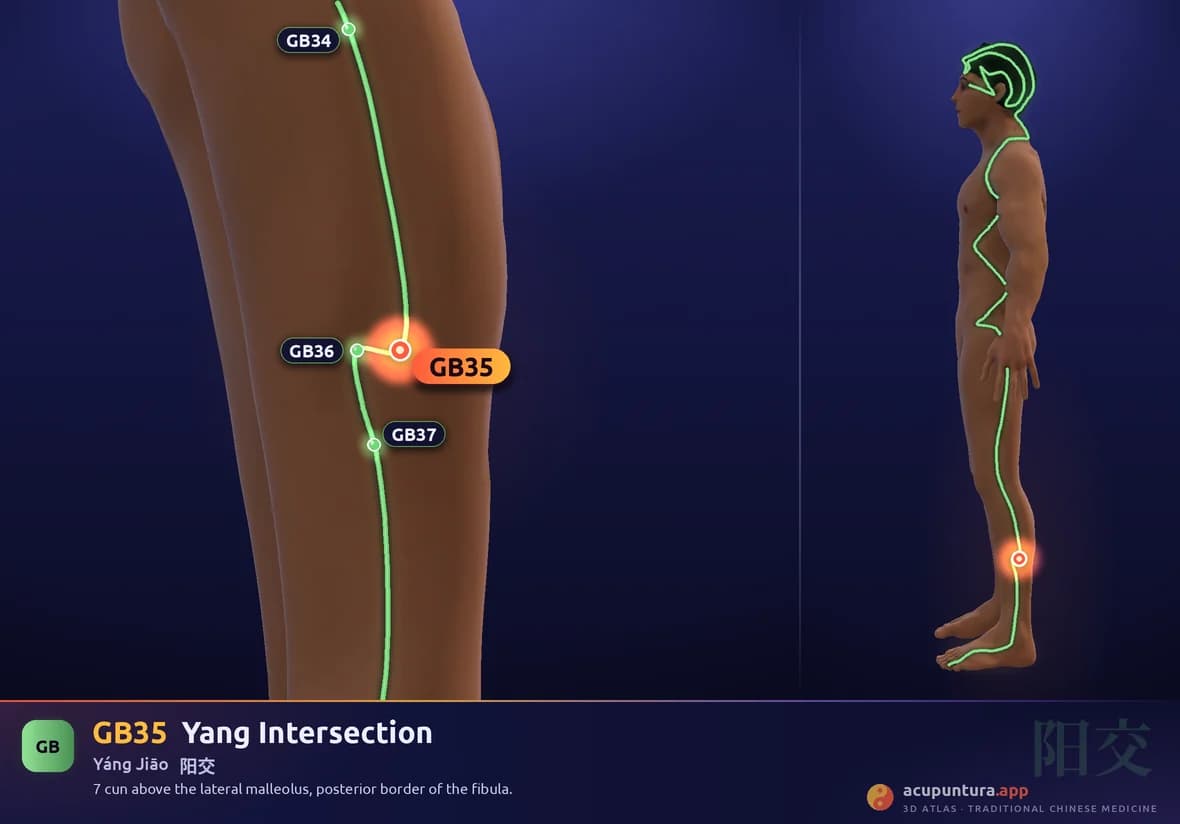
Gallbladder Channel
Yang Intersection
阳交Yáng JiāoAnatomical location
7 cun above the lateral malleolus, posterior border of the fibula.
Main function
Regulates Qi, relieves chest pain.
- Xi-Cleft point of the Yang Wei Mai
- Crossing point with the Yang Wei Mai
Therapeutic indications
- Chest pain
- hypochondriac pain
- anxiety
- costal pain
- leg pain and weakness
- swelling of the knee
- mania
- asthma
Name and classical tradition
Yangjiao, 阳交, is the “crossing of the yang.” 阳 is yang; 交, to cross, to meet. The Zhenjiu Jiayi Jing (Systematic Classic of Acupuncture and Moxibustion) describes its position with a phrase that explains it: “斜属三阳分肉间,” obliquely, in the space between the muscles of the three yang. On the outer side of the leg the foot Yang channels converge, and the name captures that meeting.
Yangjiao is the Xi-Cleft point (郄穴) of the Yang Wei Mai, the place where the Qi of that Extraordinary Vessel gathers deeply. It also has three alternate names: 别阳, “yang that separates,” and 足髎 and 足窌, two spellings of the “hollow of the foot.” Its neighbor GB36 is, in turn, the Xi-Cleft point of the Gallbladder channel itself, so within a few centimeters the leg brings together two distinct accumulation points.
Other names
- 別陽Jiayi Jing
- 足髎Jiayi Jing