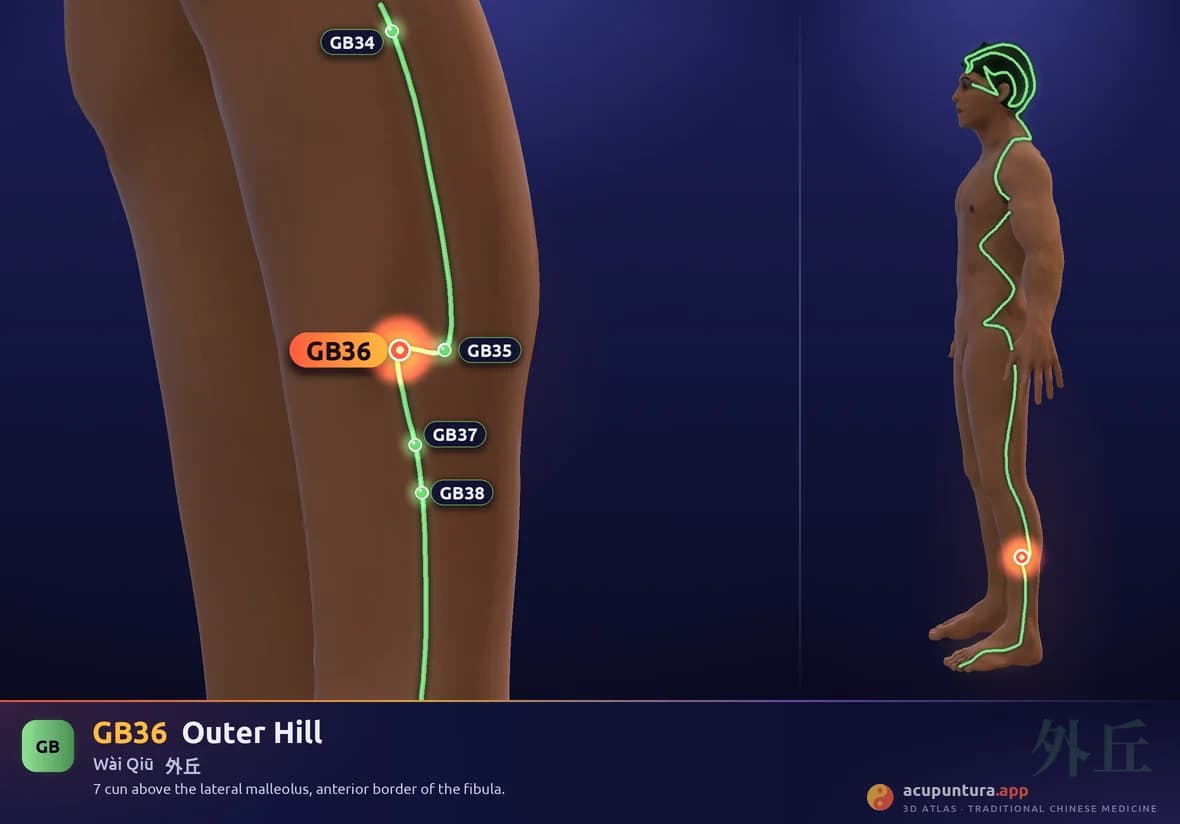
Gallbladder Channel
Outer Hill
外丘Wài QiūAnatomical location
7 cun above the lateral malleolus, anterior border of the fibula.
Main function
Regulates Qi, relieves chest pain.
- Xi-Cleft point
Therapeutic indications
- Chest pain
- hypochondriac pain
- sciatica
- costal pain
- neck pain
- leg pain
- mania
- fits of rage
Name and classical tradition
Waiqiu, 外丘, is the “outer hill.” 外 indicates the exterior, the lateral side of the leg, or else the fact of lying outside the main line of the channel; 丘 is a hill, a mound. The point sits on the anterior border of the fibula, and 丘 describes the relief of that area. The character is common in nomenclature for marking bony or muscular prominences, and it reappears at the ankle with GB40.
Waiqiu is the Xi-Cleft point (郄穴) of the Gallbladder channel, the place of deep accumulation that the tradition reserves for acute, painful conditions. Its neighbor GB35 plays the same role for the Yang Wei Mai. The sources trace it to the Zhenjiu Jiayi Jing (Systematic Classic of Acupuncture and Moxibustion). A modern gloss speaks of Qi as dust of the earth dispersing from the mound, with no citation to back it up.