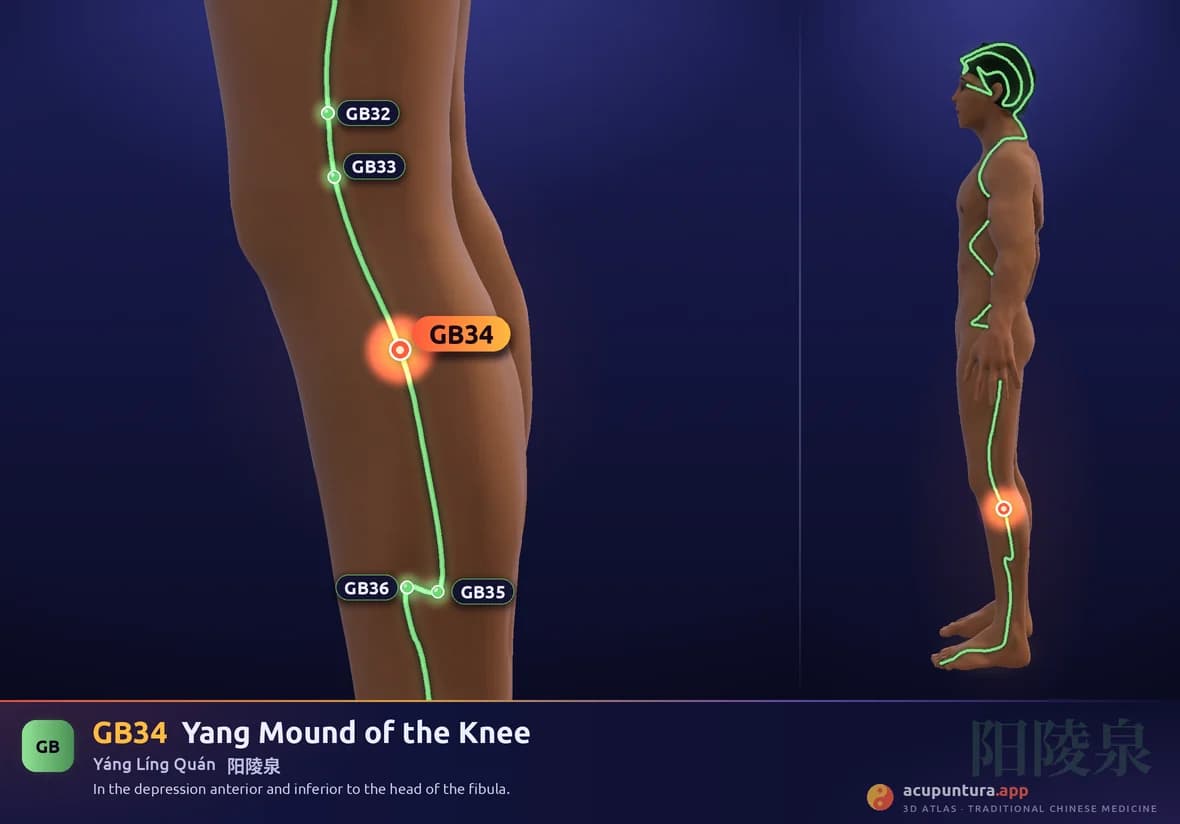
Gallbladder Channel
Yang Mound of the Knee
阳陵泉Yáng Líng QuánAnatomical location
In the depression anterior and inferior to the head of the fibula.
Main function
Regulates the Liver and Gallbladder, relieves pain.
- He-Sea point (Earth)
- Lower He-Sea point of the Gallbladder
- Influential (Hui) Point of the Sinews
Therapeutic indications
- Knee pain
- sciatica
- jaundice
- knee pain and swelling
- contractures
- cramps
- hemiplegia
- costal pain
- bitter taste in the mouth
- vomiting
- cholecystitis
- hypertension
- tendinopathies
- Parkinson’s disease (tremor due to Internal Wind)
- multiple sclerosis (Wei pattern)
- fibromyalgia
- hyperlipidemia (high cholesterol and triglycerides)
- fatty liver
- gallstones and biliary colic
- gastroesophageal reflux
- lumbar disc herniation
- rheumatoid arthritis
- knee osteoarthritis
- herpes zoster and postherpetic neuralgia
Name and classical tradition
Yanglingquan, 阳陵泉, is the “spring of the yang hill.” 阳 marks the outer side of the leg; 陵 is a hill, an elevation; 泉, a spring. The hill is the head of the fibula, the bony prominence you can feel below the knee on the outside, and the point lies in the depression in front of and below it, like a spring at the foot of a hill. It is an anatomical name with no forced metaphors.
The Lingshu (Spiritual Pivot), in the chapter Xie Qi Zang Fu Bing Xing (邪气脏腑病形), the one that sets out the He points of the yang Fu organs, says: “胆合入于阳陵泉,” the Gallbladder converges at Yanglingquan. The citation, direct, establishes that the point is at once the He-Sea point (合穴) of the channel and the Lower He-Sea point (下合穴) of the organ itself. Added to this is its status as the Influential (Hui) point of the sinews (筋会) among the Eight Influential Points (八会穴), the role that has weighed most heavily in its clinical use. For this reason it is sometimes called simply 筋会, although that is less an alias than its category.
Its alternate names are variants of the main one: 阳之陵泉, the long form, and 阳陵, the short form. Its yin counterpart, on the inner side of the knee, is SP9, Yinlingquan.