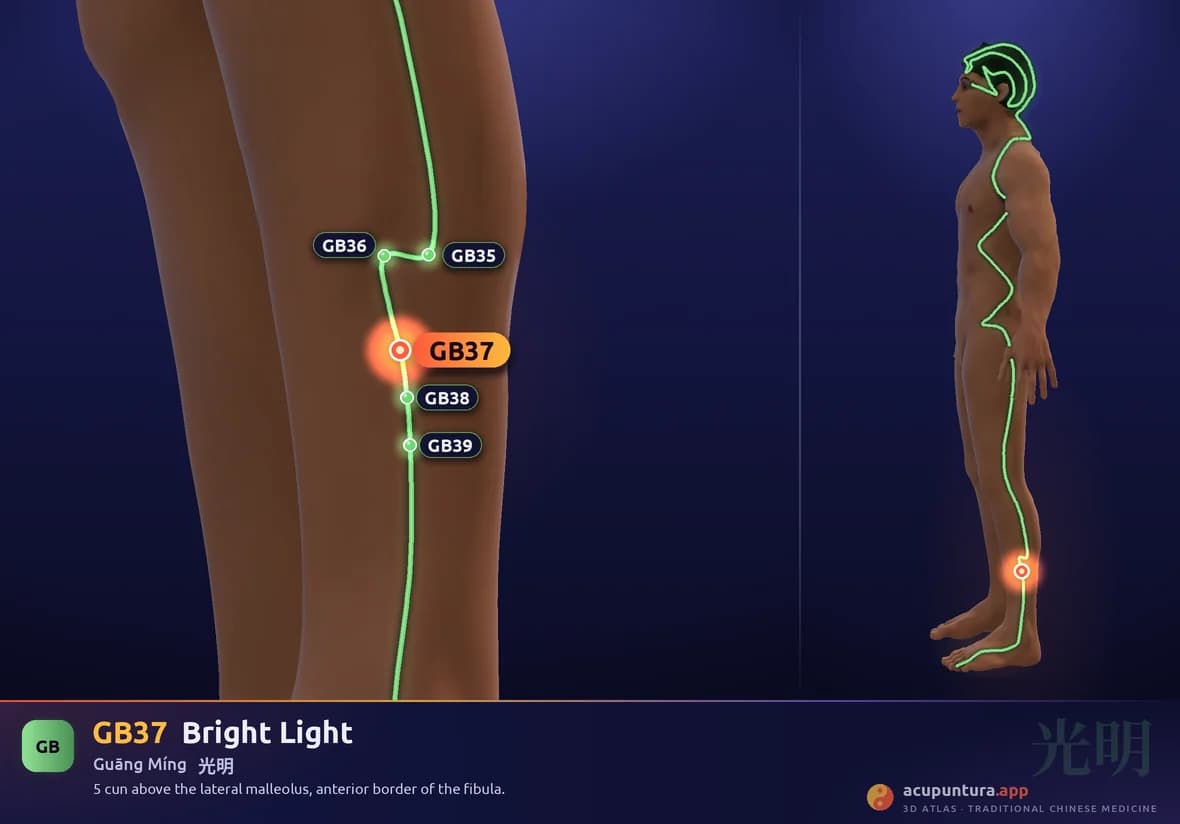
Gallbladder Channel
Bright Light
光明Guāng MíngAnatomical location
5 cun above the lateral malleolus, anterior border of the fibula.
Main function
Benefits the eyes, regulates the Liver.
- Luo (Connecting) point
Therapeutic indications
- Eye pain
- vertigo
- sciatica
- blurred vision
- night blindness
- cataracts
- leg pain and weakness
- migraine
- breast pain
Name and classical tradition
Guangming, 光明, means “light,” “brightness.” The name is explained by the function of the point and by a classical correspondence. Guangming is the Luo-Connecting point (络穴) of the Gallbladder, the one that connects with the Liver channel, the foot Jueyin. The Liver and Gallbladder form a pair, and the theory of the organs says that the Liver opens into the eyes (肝开窍于目). The point is used for eye disorders: it restores light to the eyes, hence its name.
The sources trace it to the Lingshu (Spiritual Pivot), chapter Jing Mai (经脉), the one that describes the collaterals of each channel. The Zhenjiu Jiayi Jing (Systematic Classic of Acupuncture and Moxibustion), for its part, preserves an entry with its indications: “虛則痿,坐不能起,實則厥,脛熱肘痛,身體不仁,手足偏小,善嚙頰,光明主之.” In deficiency it causes weakness, to the point of being unable to rise from a chair. In excess, cold in the extremities, heat in the leg and pain in the elbow, numbness of the body, unevenness between the hands and feet, and a tendency to bite the cheek. Guangming governs all of this. The list, made up of symptoms of the leg and body more than of the eyes, is a reminder that the ocular association of the name coexists with much broader uses.