Gallbladder Channel
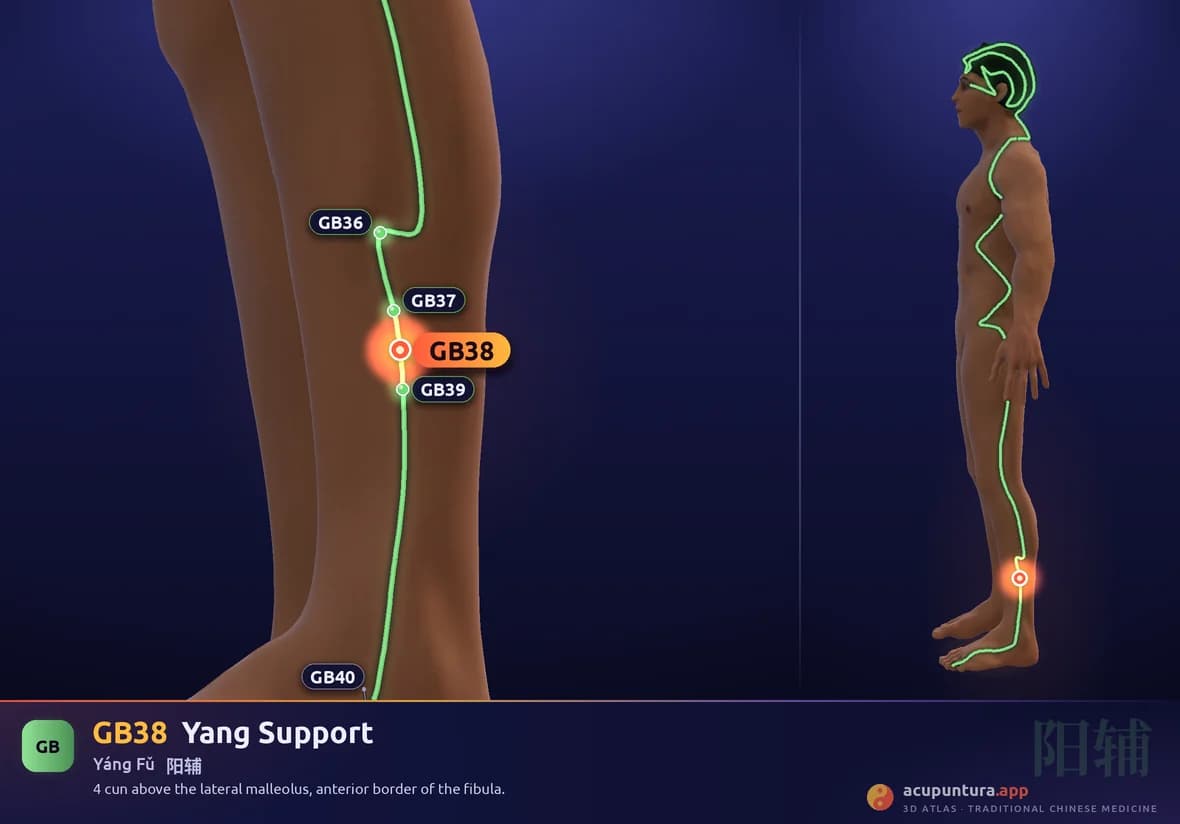
Yang Support
阳辅Yáng FǔAnatomical location
4 cun above the lateral malleolus, anterior border of the fibula.
Main function
Regulates the Liver, relieves pain.
- Jing-River point (Fire)
- Sedation Point
Therapeutic indications
- Hypochondriac pain
- sciatica
- headache
- migraine
- pain at the outer canthus of the eye
- costal pain
- axillary pain
- scrofula
- leg pain
- malaria
Ryodoraku
- Sedation of Gallbladder
Name and classical tradition
Yangfu, 阳辅, is an anatomical name without ornament. 辅骨, “auxiliary bone,” is the classical term for the fibula, the bone that accompanies and assists the tibia; 阳, the outer side. The point is, quite simply, the one on the yang side of the auxiliary bone.
The Lingshu (Spiritual Pivot), in the chapter Ben Shu (本输), describes it precisely: “外踝之上,辅骨之前,及绝骨之端,” above the lateral malleolus, in front of the fibula, at the end of what it calls 绝骨, the “bone that ends.” It is the Jing-River point (经穴) of the channel among the Five Shu points, and therefore one of the points on the channel with the oldest attestation.
That 绝骨 in the quotation matters beyond this point. It is the alternate name, and the most used in the clinic, of its neighbor GB39, and its appearance here as a general anatomical reference for the area lies at the root of the old debate over exactly which point 绝骨 is.