GB39

Gallbladder Channel

Hanging Bell

悬钟Xuán Zhōng

Anatomical location

3 cun above the lateral malleolus, anterior border of the fibula.

Main function

Benefits the bone marrow, relieves pain.

  • Hui point of the Marrow

Therapeutic indications

  • Neck pain
  • sciatica
  • hemiplegia
  • neck stiffness
  • torticollis
  • costal pain
  • leg pain and weakness
  • hemorrhoids
  • epistaxis
  • anemia
  • tinnitus
  • Parkinson’s disease (tremor due to Internal Wind)
  • multiple sclerosis (Wei pattern)
  • ankylosing spondylitis
  • rheumatoid arthritis
  • osteoporosis

Name and classical tradition

Xuanzhong, 悬钟, is the “hanging bell.” 悬 means to hang, as in GB5 and GB6; 钟 is the bell or small jingle bell. The most repeated explanation is folkloric: in ancient China, children wore little bells hung right here, above the ankle. It is a widely circulated folk etymology, but no classical citation supports it, and it is best taken as oral tradition.

The point is better known by its other name, 绝骨, “where the bone ends”: the end of the fibula that you can palpate above the lateral malleolus. The term appears in the Lingshu (Spiritual Pivot), in the description of GB38, as a general anatomical reference for the area, which suggests that 绝骨 was first a landmark on the body and only later the name of a point. Hence a debate that continues to this day over whether Xuanzhong and 绝骨 are exactly the same point. Some authors maintain that they are not.

Xuanzhong is the Influential point of marrow (髓会), one of the eight Influential points (八会穴). The reference works also give it the names 阳维, 髓孔 and, once again, 髓会. The attribution goes back to the Zhenjiu Jiayi Jing (Systematic Classic of Acupuncture and Moxibustion).
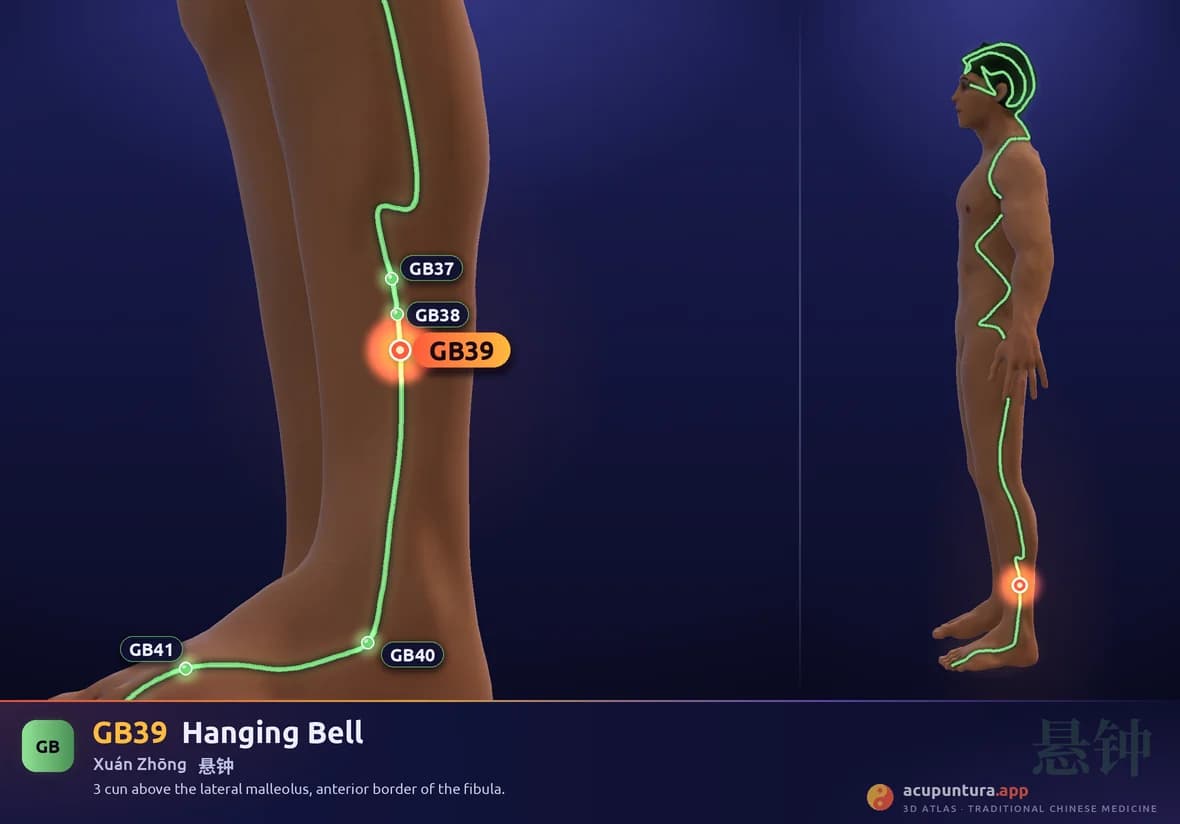

Location of point GB39, Hanging Bell
CC BY-ND 4.0 (opens in a new tab)
View point on the 3D modelGB39 on the anatomy
Needling techniquePerpendicular insertion 0.8-1.2 cun.
Depth0.8-1.2 cun
MoxibustionApplicable (5-10 minutes, indirect moxa)
PrecautionsAvoid deep needling to prevent nerve damage.

Patterns that use it · 1

Classical combinations · 2

  • The Eight Influential Points八会穴Bā Huì XuéInfluential (Hui) point of each substance or tissue: Zang LR13, Fu CV12, Qi CV17, Blood BL17, tendons GB34, vessels LU9, bones BL11, marrow GB39.
  • Sinews and bonesThe three Influential (Hui) points of the musculoskeletal system: tendons, bones, and marrow.

Basic formulas from the vademecum · 2

View the vademecum

Named functional sets from the school: here the point does not act on its own, but through the role it plays within the maneuver.

  • Tonify the Triple Energizer as a wholeKidney Yang as the fire that moves the Triple Energizer, plus the two group Luo points of the Yang channels: TE8 gathers the three Yang channels of the hand and GB39 the three Yang channels of the foot.
  • Group LuoPregnancyThe four points that each govern three channels: SP6 the three Yin channels of the foot, PC5 the three Yin channels of the hand, TE8 the three Yang channels of the hand, and GB39 the three Yang channels of the foot. Twelve channels with four needles.
Cover of the guide “Protocols for the 20 most common patterns”

Free guide · PDF

Protocols for the 20 patterns you see most in practice

Each pattern with its tongue, its pulse, the treatment principle and the points to tonify and disperse. Made for the treatment table, not the bookshelf.

Do you use GB39 with your patients?

In the Clinic you record it in the patient's file, next to the tongue, the pulse and the measurements, so at the next session you know exactly what you used. The Atlas is built in.

See the Clinic