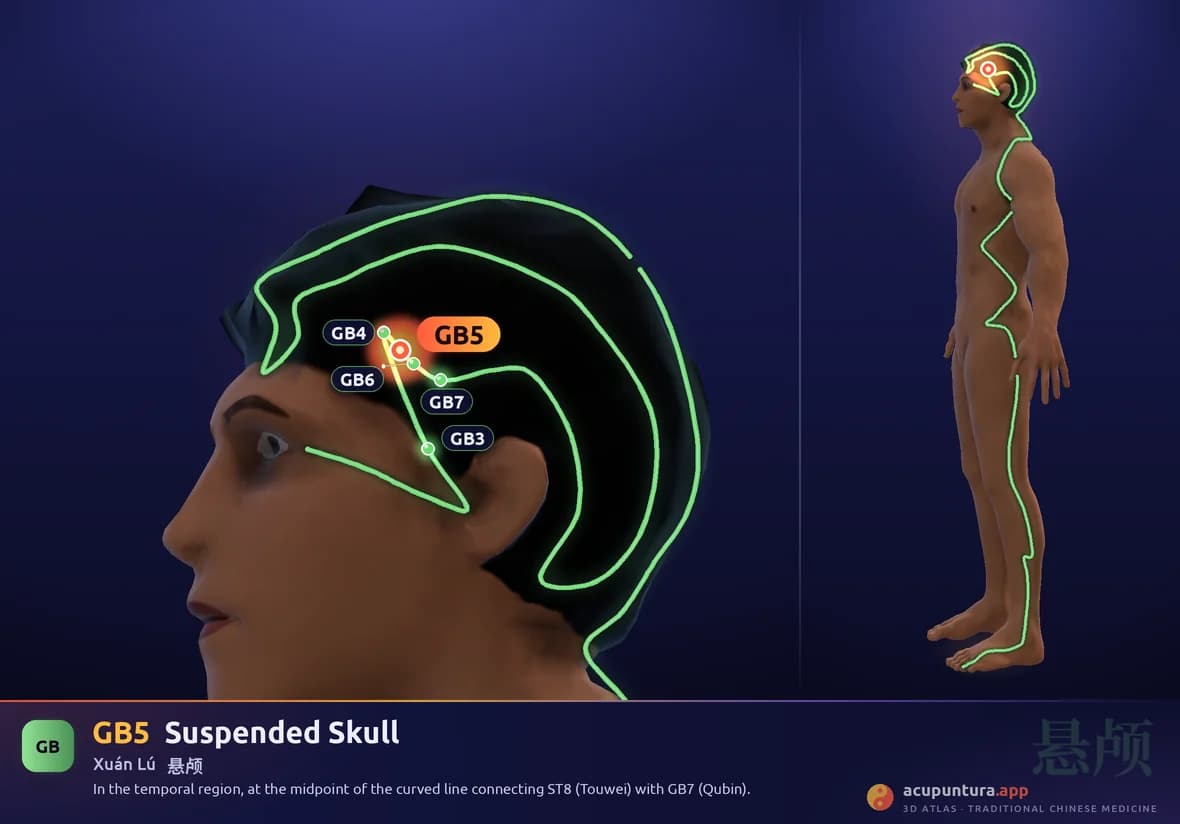
Gallbladder Channel
Suspended Skull
悬颅Xuán LúAnatomical location
In the temporal region, at the midpoint of the curved line connecting ST8 (Touwei) with GB7 (Qubin).
Main function
Eliminates Wind-Heat, relieves headache.
Therapeutic indications
- Migraine
- eye pain
- vertigo
- Facial pain
- Epistaxis
- Fever
Name and classical tradition
Xuanlu, 悬颅, means "suspended skull": 悬 is "to hang," and 颅 is the cranial vault. A modern gloss links it to vertigo, the sensation of the head hanging in the void, and to the idea that the Qi of the preceding point, GB4, descends here along the side of the skull. It is a suggestive reading, but no classical citation supports it.
The character 悬 is not unique to this point. It is shared with its immediate neighbor, GB6, and reappears much farther down, at the ankle, with GB39, the "hanging bell." Within the Gallbladder channel it thus forms a small family of names of suspended things.
The textual origin of the point is doubtful: one reference places it in the Lingshu (Spiritual Pivot), chapter Han Re Bing, and most sources in the Zhenjiu Jiayi Jing (Systematic Classic of Acupuncture and Moxibustion), and it has not been possible to resolve which is correct. The reference works give it the alternative names 髓孔, 髓中, and 米啮.