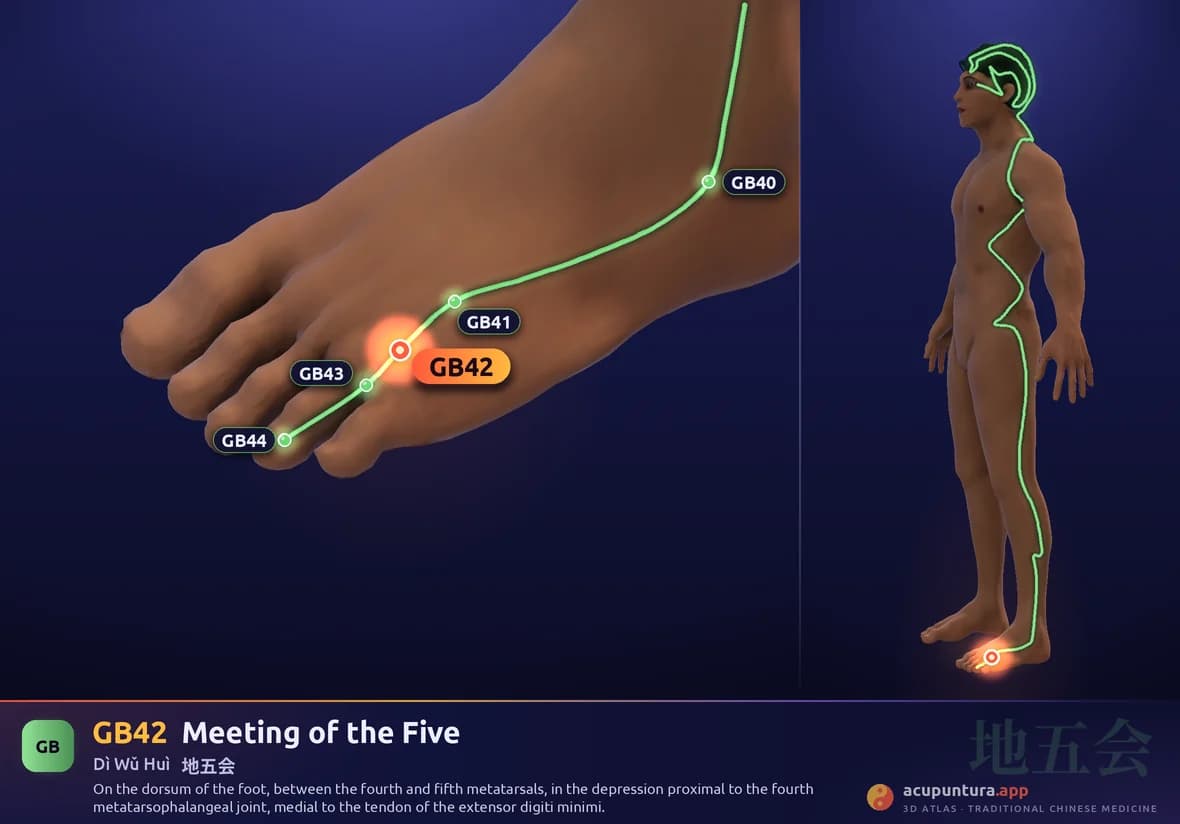
Gallbladder Channel
Meeting of the Five
地五会Dì Wǔ HuìAnatomical location
On the dorsum of the foot, between the fourth and fifth metatarsals, in the depression proximal to the fourth metatarsophalangeal joint, medial to the tendon of the extensor digiti minimi.
Main function
Regulates the Liver, benefits the eyes.
Therapeutic indications
- Foot pain
- headache
- tinnitus
- eye pain
- mastitis
- costal pain
- pain and swelling of the dorsum of the foot
Name and classical tradition
Diwuhui, 地五会, means “meeting of the five on the earth.” 地, earth, is the counterpart of 天, heaven: in the correspondence of heaven, humanity, and earth, the foot is the earthly part of the body. 五 is five, and 会 is meeting. The interpretation the reference works offer is that here the Qi of the Gallbladder corresponds with that of the other five channels, in the part of the body that touches the ground. It is a reasoned reading, but it has no classical citation.
The firmest fact about the point is a prohibition. The Zhenjiu Jiayi Jing (Systematic Classic of Acupuncture and Moxibustion) includes Diwuhui among the points where moxibustion must not be applied (禁灸穴): Huangfu Mi set technique restrictions for a series of specific points, and this is one of them. The text confirms it twice: in the point's own entry, «不可灸,灸之令人瘦,不出三年死», no moxibustion, because it makes a person thin and kills in under three years; and in the list of forbidden points, «地五會禁不可灸(使人瘦)». It is a good example of how the tradition not only named and located points but also marked where not to intervene.