Gallbladder Channel
Falling Tears
足临泣Zú Lín QìUse caution during pregnancy
Opening point of the Dai Mai, which girdles the uterus. Strong dispersion is not advised.
Anatomical location
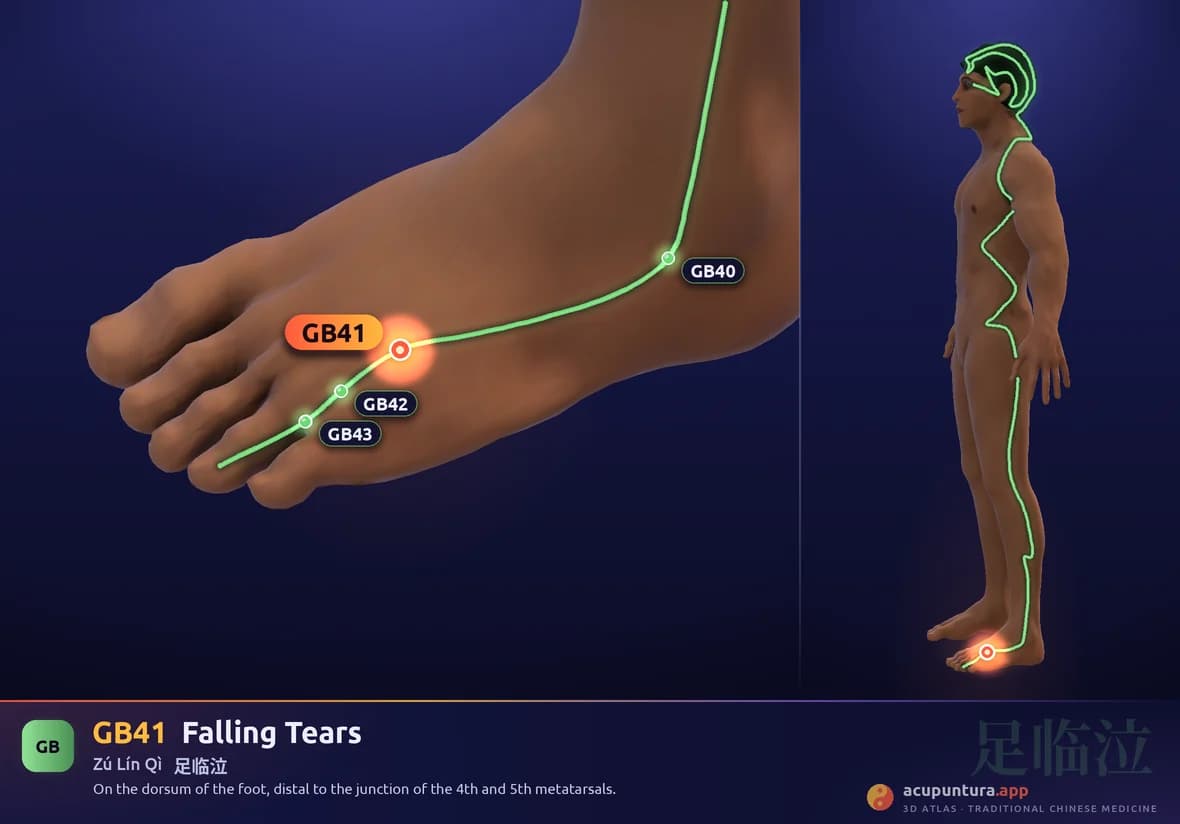
On the dorsum of the foot, distal to the junction of the 4th and 5th metatarsals.
Main function
Regulates Dai Mai, benefits the eyes.
- Shu-Stream point (Wood)
- Opening point of the Dai Mai
Therapeutic indications
- Foot pain
- headache
- leukorrhea
- migraine
- eye pain
- tinnitus
- deafness
- mastitis
- mastalgia
- irregular menstruation
- costal pain
- scrofula
- pain on the dorsum of the foot
- gallstones and biliary colic
- premenstrual syndrome
- rheumatoid arthritis
- herpes zoster and postherpetic neuralgia
Name and classical tradition
Zulinqi, 足临泣, is the “Linqi of the foot.” In the Lingshu (Spiritual Pivot), Ben Shu (本输) chapter, it was called simply 临泣. In the Song period, the Shengji Zonglu added 足 to separate it from its namesake on the head, GB15. The reference works also record the form 下临泣, “lower Linqi.”
临 means to look down from above, to overlook; 泣 means tears. The connection with the eyes is understood through the doctrine of the five transport points: Zulinqi is the Shu-Stream point (输穴) of the channel, which on yang channels corresponds to Wood, and Wood is the Phase of the Liver, which opens into the eyes. So a point on the foot carries tears in its name, just like its namesake on the forehead. The Zhenjiu Jiayi Jing (Systematic Classic of Acupuncture and Moxibustion) gives the location: «臨泣者,木也。在足小指次指本節後間陷者中,去俠溪一寸五分», Linqi is Wood; it lies in the depression behind the joints of the fourth and fifth toes, one and a half cun from Xiaxi.
Besides being a Shu-Stream point, it has another feature of great clinical weight: it is one of the eight confluent points (八脉交会穴), the one that opens the Dai Mai (Girdle Vessel), which is associated with GB26, GB27 and GB28.