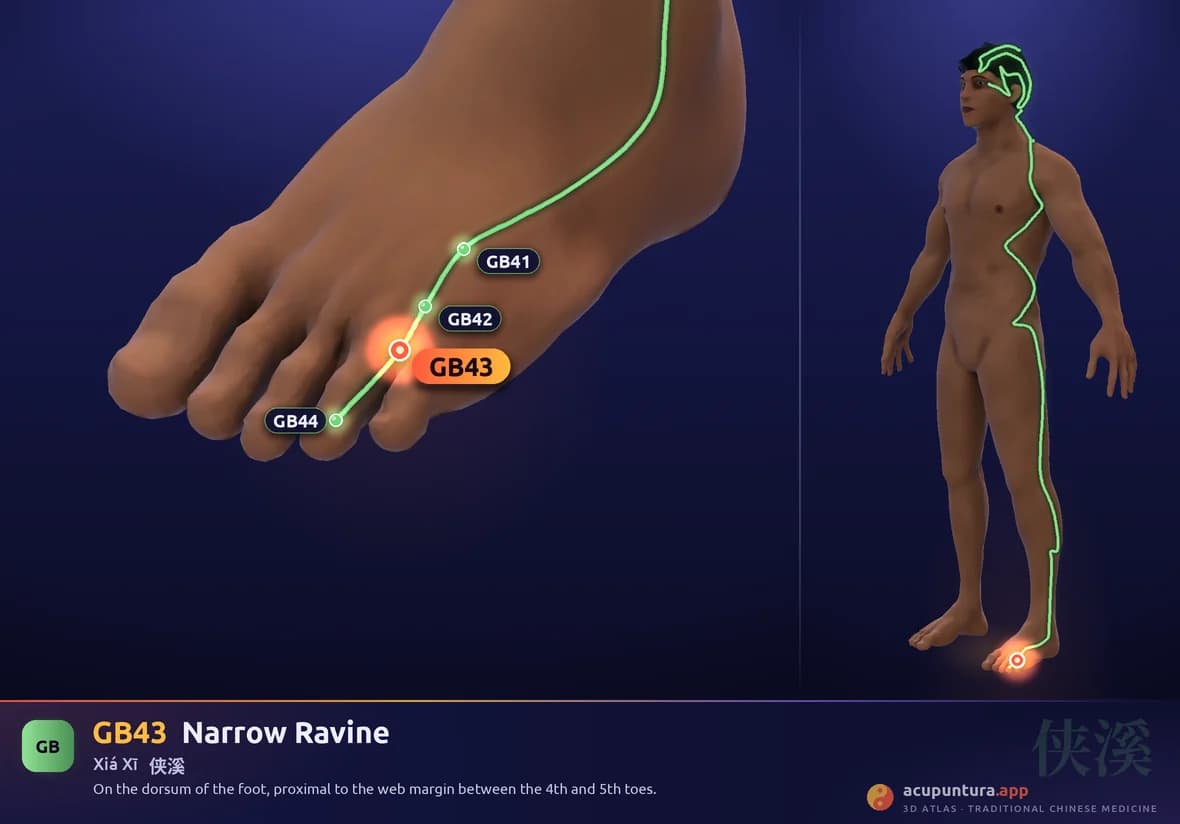
Gallbladder Channel
Narrow Ravine
侠溪Xiá XīAnatomical location
On the dorsum of the foot, proximal to the web margin between the 4th and 5th toes.
Main function
Regulates the Liver, benefits the eyes.
- Ying-Spring Point (Water)
- Tonification Point
Therapeutic indications
- Foot pain
- headache
- tinnitus
- migraine
- eye pain
- deafness
- costal pain
- mastitis
- fever
- pain on the dorsum of the foot
Ryodoraku
- Tonification of Gallbladder
Name and classical tradition
Xiaxi, 侠溪, is the “narrow stream” or “flanked stream.” 侠 is a variant of 夹, “to squeeze between two,” “to flank,” the same character that appears in LU4; 溪 is a stream, a ravine, and in point nomenclature it designates the narrow clefts between toes or between bones. The point lies in the web between the fourth and fifth toes, squeezed between the two. The image is precise.
The Lingshu (Spiritual Pivot), Ben Shu (本输) chapter, devotes a full sentence to it: «胆溜于侠溪。侠溪,足小指次指之间也。为荥». The Qi of the Gallbladder flows to Xiaxi; Xiaxi is between the fourth and fifth toes; it is the Ying-Spring point (荥穴). On the yang channels, the Ying-Spring point corresponds to Water. The verb 溜, “to flow,” “to slide,” describes the Qi that begins to run after gushing out at the previous point, GB44, like a stream that has just left its well.