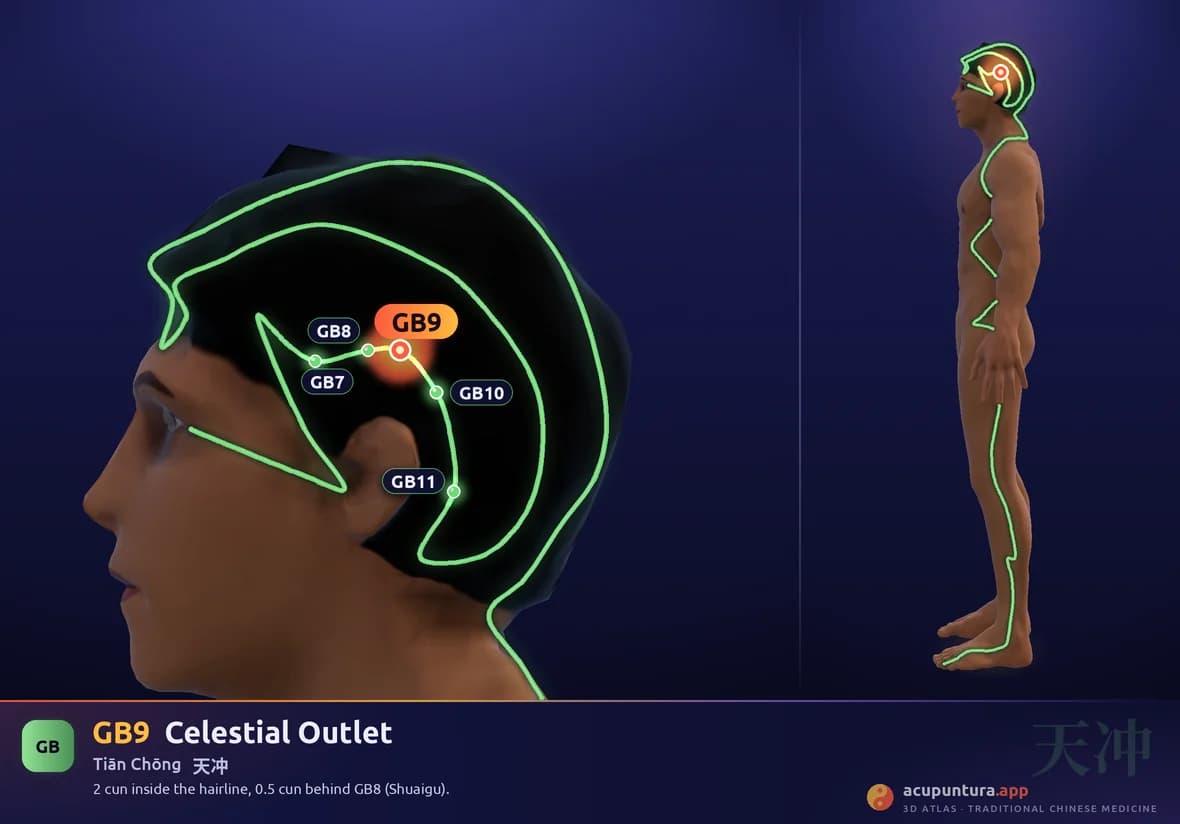
Gallbladder Channel
Celestial Outlet
天冲Tiān ChōngAnatomical location
2 cun inside the hairline, 0.5 cun behind GB8 (Shuaigu).
Main function
Eliminates Wind, calms the Shen, relieves headache.
Therapeutic indications
- Headache
- vertigo
- tinnitus
- epilepsy
- Goiter
- Gum pain
- Fear
Name and classical tradition
Tianchong, 天冲, combines 天, "heaven," which in point nomenclature usually indicates the upper part of the body, and 冲, which can be read as "important thoroughfare" or as "to burst forth," "to project upward." The point is high on the head, behind the ear, and is a crossing point of the foot Taiyang and Shaoyang. "Celestial thoroughfare" or "heavenly crossroads" are reasonable translations.
This idea of a crossroads is confirmed by the alternative name Sun Simiao gives it in the Beiji Qianjin Yaofang, in the Tang period: 天衢. 衢 is the crossroads where roads open in several directions, the same semantic field as 冲 but more explicit. The attribution to Sun Simiao is specific, although the passage has not been checked line by line. The main name goes back to the Zhenjiu Jiayi Jing (Systematic Classic of Acupuncture and Moxibustion).