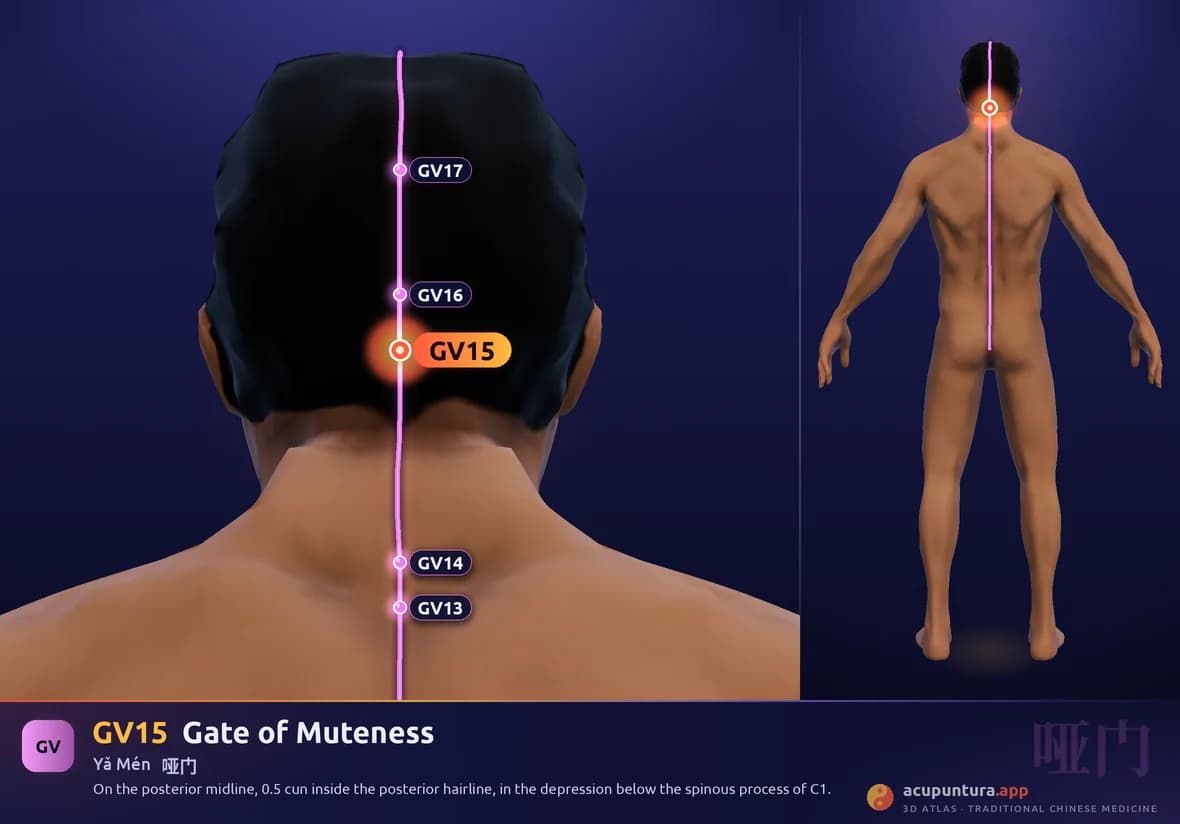
Du Mai (Governing Vessel) Channel
Gate of Muteness
哑门Yǎ MénAnatomical location
On the posterior midline, 0.5 cun inside the posterior hairline, in the depression below the spinous process of C1.
Main function
Expels Wind, benefits the tongue, calms the Shen.
- Window of Heaven point
- Crossing point with the Yang Wei Mai
Therapeutic indications
- Stiff neck
- loss of voice
- epilepsy
- headache
- Sudden loss of voice
- Aphasia
- Stiffness of the tongue
- Headache
- Nosebleed
- Deaf-mutism
Name and classical tradition
Yamen, 哑门, is the “gate of muteness.” 哑 (啞) means mute, without a voice; 门 is the gate. The name has been written in several ways, and its evolution is well documented. The Suwen (Basic Questions), in the chapter Qi Xue Lun (氣穴論), calls it 瘖門; Sun Simiao’s Qianjin Yifang (Supplement to the Prescriptions Worth a Thousand Gold) writes 瘂門, and the modern form, 啞門, is relatively recent. All three characters, 瘖, 瘂, and 啞, express the same idea of loss of speech.
The Zhenjiu Jiayi Jing (Systematic Classic of Acupuncture and Moxibustion) places it «在後髮際宛宛中,入系舌本,督脈陽維之會»: in the depression at the hairline of the nape; from here one enters to the root of the tongue; it is a meeting point of the Du Mai and the Yangwei. That connection with the tongue explains both the name and its use in loss of speech. The same entry ends with a warning that gives the name its meaning: «不可灸,灸之令人喑», no moxa, because it leaves the person mute. In later tradition, its reputation for danger extended to deep needling as well, because of the proximity of the medulla oblongata.
Its alternative names are already in the Jiayi Jing, which records it as «喑門,一名舌橫,一名舌厭»: Yinmen, also called Sheheng and Sheyan, both referring to the tongue. The Zhenjiu Dacheng (Great Compendium of Acupuncture and Moxibustion) repeats them.
Other names
- 舌橫Jiayi Jing
- 舌厭Jiayi Jing