Du Mai (Governing Vessel) Channel
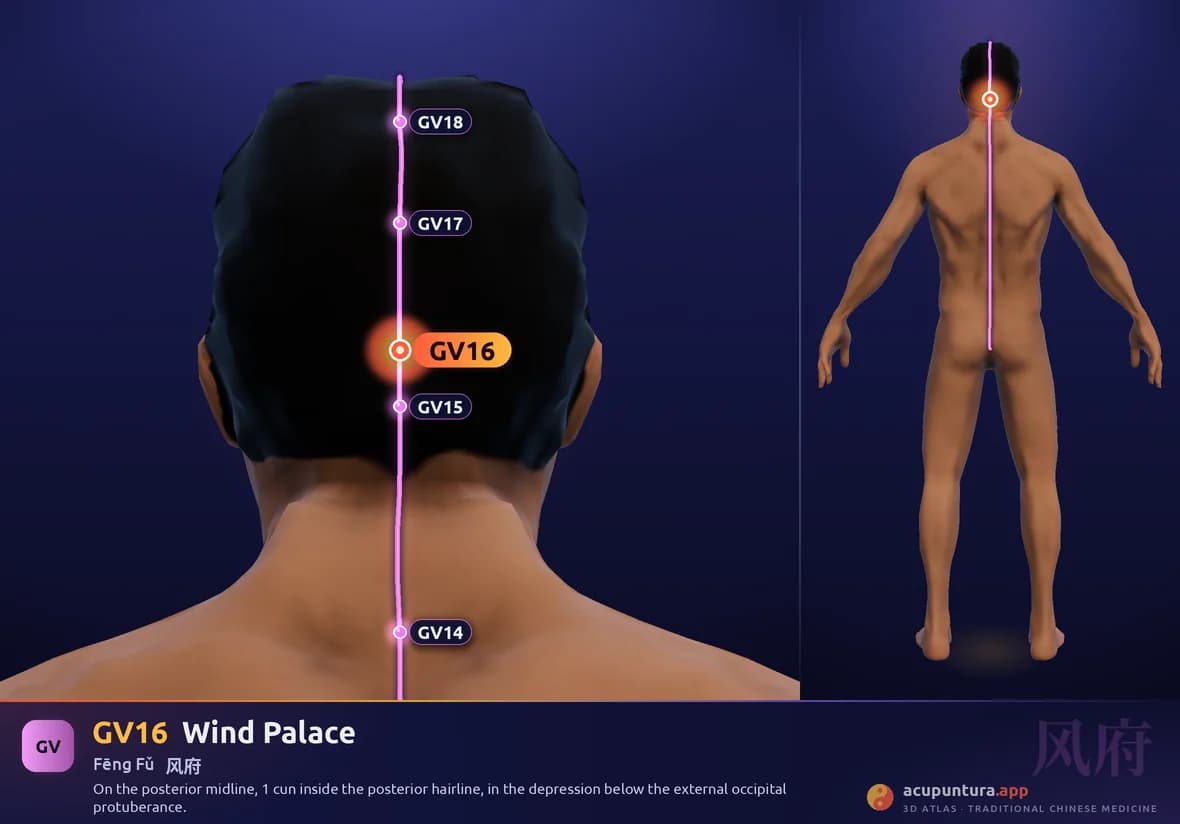
Wind Palace
风府Fēng FǔAnatomical location
On the posterior midline, 1 cun inside the posterior hairline, in the depression below the external occipital protuberance.
Main function
Expels Wind, benefits the head, calms the Shen.
- Sea of Marrow point
- Crossing point with the Bladder and Yang Wei Mai
Therapeutic indications
- Headache
- vertigo
- stiff neck
- epilepsy
- Occipital headache
- Stroke
- Aphasia
- Epistaxis
- Sore throat
- Common cold
- Mania
- Schizophrenia (Dian Kuang)
Name and classical tradition
Fengfu, 风府, is the “mansion of Wind.” 风 (風) is wind, the pathogenic factor that enters from outside; 府 is the mansion, the storehouse. The point lies below the occipital bone, on the midline of the nape, and the tradition considered it the place where Wind enters toward the brain. Hence its importance in treating Wind: Wind stroke, stiff neck, headache.
The Suwen (Basic Questions), in the chapter Gu Kong Lun (骨空論), prescribes it for exactly that: «風從外入,令人振寒,汗出頭痛,身重惡寒,治在風府». When Wind enters from outside and causes chills, sweating, headache, heaviness, and aversion to cold, the treatment lies in Fengfu. It is a meeting point of the Du Mai and the Yangwei, like its neighbor GV15, and the two share a reputation as risky points if needled deeply.
The Zhenjiu Jiayi Jing (Systematic Classic of Acupuncture and Moxibustion) gives it an alternative name, «風府,一名舌本», root of the tongue, and counts it among the points where moxa is not applied. In Sun Simiao’s Qianjin Yaofang (Essential Prescriptions Worth a Thousand Gold), Fengfu appears twice in the list of the spirit points: as the sixth of the thirteen, 鬼枕, “pillow of the spirits,” and as the treatment for the illness that makes a person sleep without awareness, «風府主之(一名鬼穴)». With GB20, Fengchi, and BL12, Fengmen, it forms the series of Wind points of the nape and upper back.
Other names
- 舌本Jiayi Jing
- 鬼穴Qianjin Yaofang