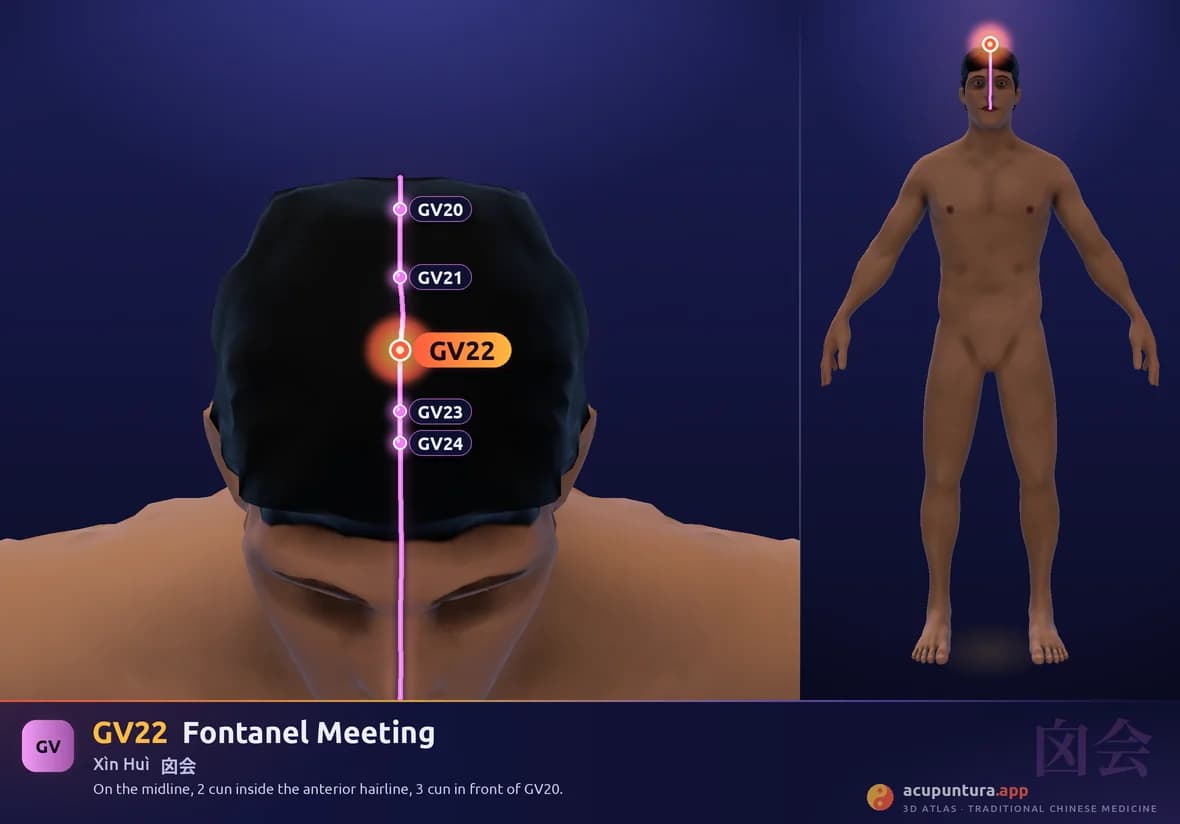
Du Mai (Governing Vessel) Channel
Fontanel Meeting
囟会Xìn HuìAnatomical location
On the midline, 2 cun inside the anterior hairline, 3 cun in front of GV20.
Main function
Calms Internal Wind, benefits the head, improves vision.
Therapeutic indications
- Headache
- vertigo
- sinusitis
- blurred vision
- Cephalalgia
- Nasal congestion
- Epistaxis
- Drowsiness
Name and classical tradition
Xinhui, 囟会, is the “union of the fontanelle.” 囟 is the fontanelle; 会 (會), the union, the confluence. The point lies where the coronal and sagittal sutures of the skull meet, the site of the anterior fontanelle, which is open in the newborn and closes with growth. The name records a precise anatomical observation.
For that very reason, the tradition has counted it among the points requiring caution, especially in small children, whose fontanelle has not closed. The sources trace it to the Lingshu (Spiritual Pivot), to the chapter Re Bing (熱病), an attribution that contrasts with that of most Du Mai points, although no literal citation has been recovered. Reference works attribute to it the alternative names 囟門, 頂門, and 囟中, all alluding to the fontanelle and the crown of the head. And Sun Simiao’s Qianjin Yaofang (Essential Prescriptions Worth a Thousand Gold) gives it another from the tradition of the spirits: «囟上主之(一名鬼門)», the gate of the spirits, for the illness that makes the four limbs heavy.