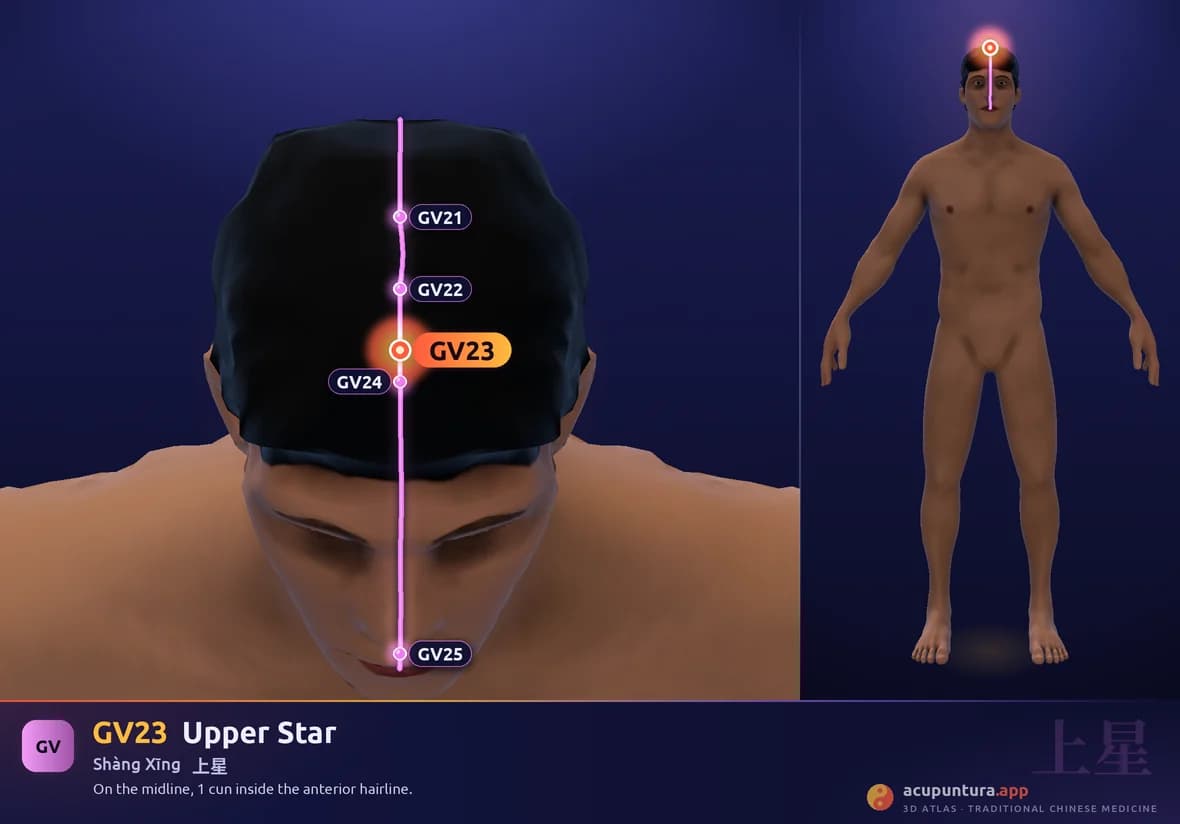
Du Mai (Governing Vessel) Channel
Upper Star
上星Shàng XīngAnatomical location
On the midline, 1 cun inside the anterior hairline.
Main function
Expels Wind, benefits the nose and eyes, calms the Shen.
Therapeutic indications
- Headache
- sinusitis
- nosebleed
- blurred vision
- Nasal congestion
- Rhinitis
- Epistaxis
- Frontal headache
- Eye pain
- Mania
- Schizophrenia (Dian Kuang)
- Allergic rhinitis
Name and classical tradition
Shangxing, 上星, is the “star above.” 上 is above, the head; 星, the star, which here is understood as essence, refined Qi. The point lies on the midline of the forehead, one cun inside the hairline, and the sources describe it as the place where refined Yang gathers and whose radiance illuminates in every direction (精英四照). Its aliases also come from that image of light.
Reference works attribute three alternative names to it: 明堂, “bright hall,” 神堂, “hall of the spirit,” and 鬼堂, “hall of the spirits.” The last is the tenth of the thirteen spirit points of Sun Simiao’s Qianjin Yaofang (Essential Prescriptions Worth a Thousand Gold): «直鼻上入髮際一寸名鬼堂…即上星穴也», one cun inside the hairline, in line with the nose. The alias 神堂 coincides with the name of BL44, Shentang, a point on the back, which may have caused confusion in some reference works. The Zhenjiu Jiayi Jing (Systematic Classic of Acupuncture and Moxibustion), the first work to record it, locates it with a homely comparison: «入髮際一寸陷者中,可容豆», one cun inside the hairline, in a hollow where a bean fits.
Other names
- 鬼堂Qianjin Yaofang