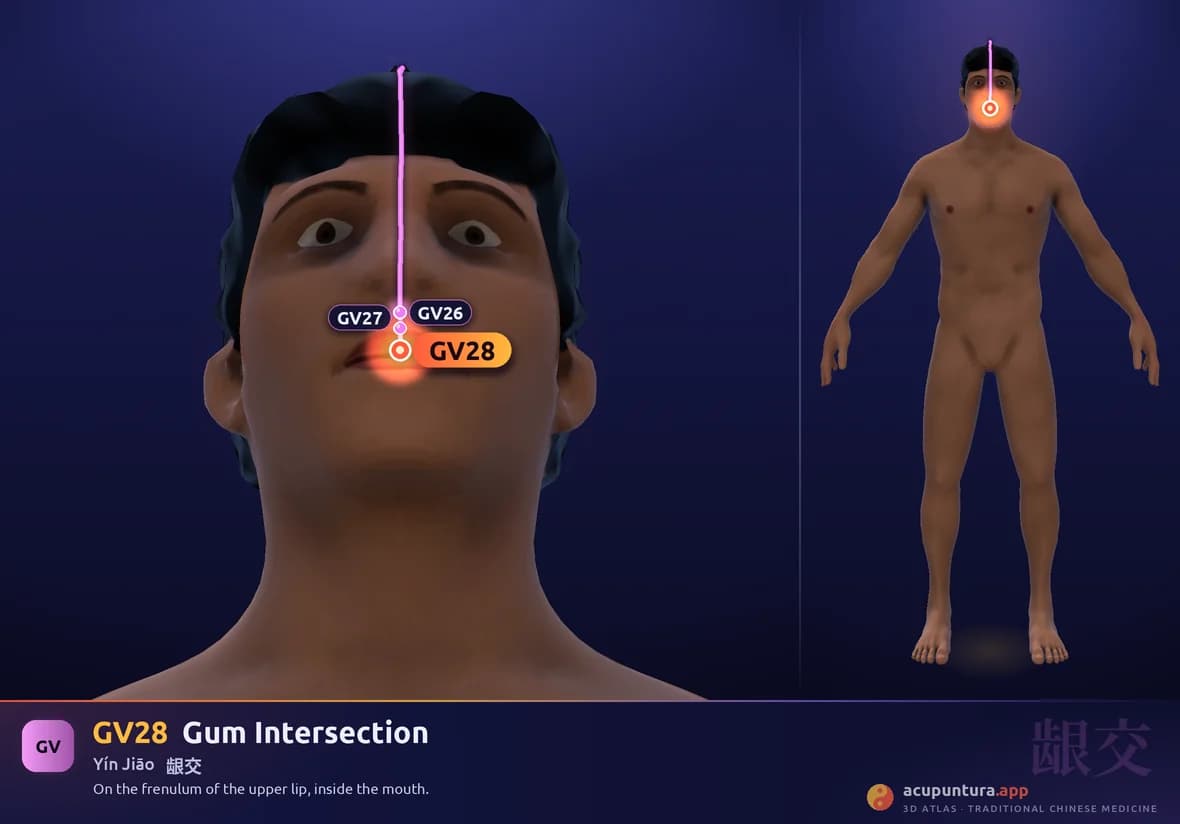
Du Mai (Governing Vessel) Channel
Gum Intersection
龈交Yín JiāoAnatomical location
On the frenulum of the upper lip, inside the mouth.
Main function
Expels Wind, calms the Shen, benefits the mouth.
- Crossing point with the Ren Mai
Therapeutic indications
- Toothache
- gingivitis
- facial paralysis
- gum pain and swelling
- stomatitis
- rhinitis
- nasal obstruction
- eye pain
Name and classical tradition
Yinjiao, 龈交, is the “gum junction.” 龈 (齦) is the gum; 交 is the crossing, the meeting. The point is inside the mouth, where the frenulum of the upper lip joins the gum, and the name describes it exactly. It is also a meeting point of the Du Mai with the Yangming.
The Suwen (Basic Questions), in the Qi Fu Lun chapter (氣府論), lists the points where the Qi of the Du Mai emerges and counts them: «督脈氣所發者二十八穴», twenty-eight points, and the list includes «齦交一». This shows that the number of points attributed to the Du Mai today, twenty-eight, is already present in the canon. In the ancient text the character was written 齗, a graphic variant of 齦.
Yinjiao is where the Du Mai ends. It began at the coccyx, at GV1, ran up the spine and over the head, and ends here, in the mouth. The sources attribute to it indications from the Zhenjiu Jiayi Jing (Systematic Classic of Acupuncture and Moxibustion) such as convulsive stiffness, agitation, epilepsy, eye pain, blood between the teeth, and nasal polyps.