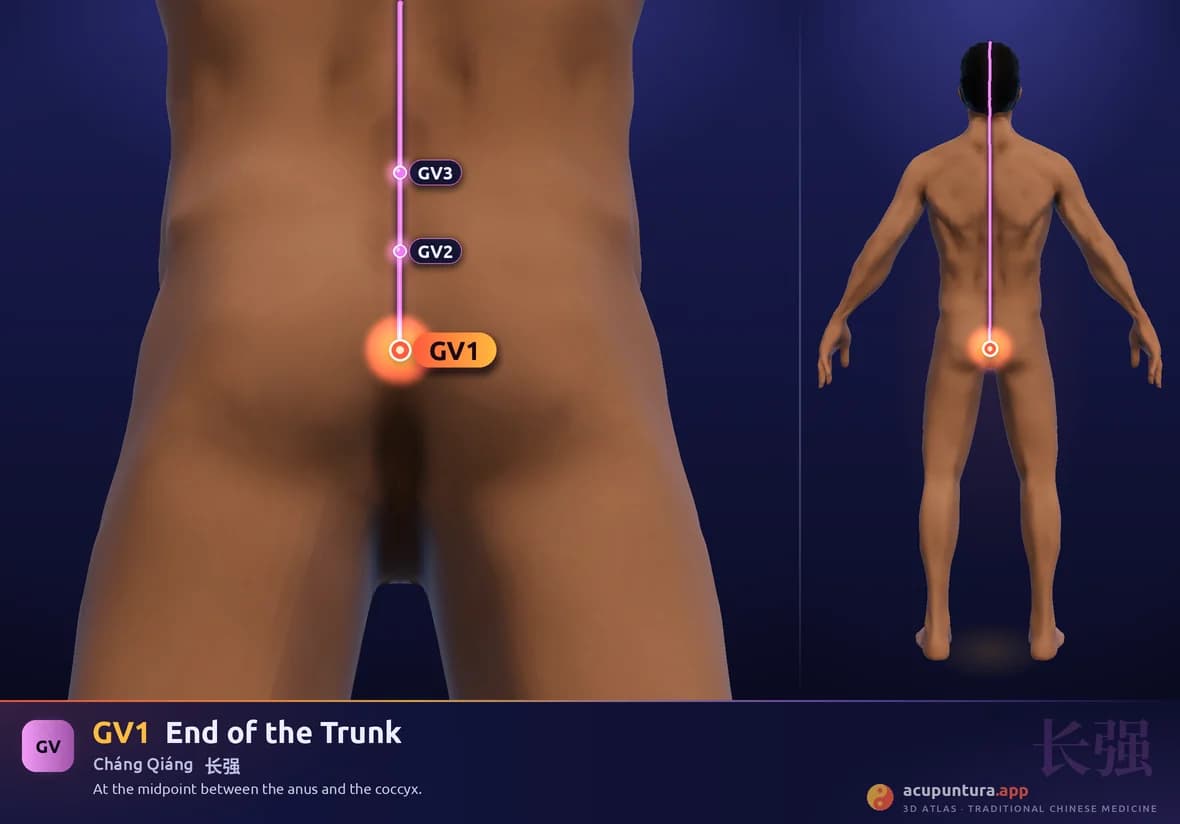
Du Mai (Governing Vessel) Channel
End of the Trunk
长强Cháng QiángAnatomical location
At the midpoint between the anus and the coccyx.
Main function
Regulates the Large Intestine, strengthens Yang, lifts Qi.
- Great Luo of the Du Mai
- Crossing point with the Ren Mai, Kidney, and Bladder
Therapeutic indications
- Rectal prolapse
- hemorrhoids
- diarrhea
- low back pain
- epilepsy
- constipation
- rectal bleeding
- coccygeal pain
- impotence
Name and classical tradition
Changqiang, 长强, is the “lasting strength.” 长 (長) means long, continuous, what circulates without interruption; 强 (強), strong, robust, unceasing. The point is at the tip of the coccyx, where the Du Mai begins, and the usual reading ties it to the spine that starts here: flexible, able to bend and rotate, and at the same time the support of the whole weight of the body. Its Qi would circulate endlessly and with vigor.
Changqiang is the Luo-Connecting point (絡穴) of the Du Mai. Sources trace it to the Lingshu (Spiritual Pivot), to the Jing Mai chapter (經脈), which describes the collaterals and opens the Du Mai’s with the formula “督脈之別,名曰長強”, the collateral of the Du Mai is called Changqiang. As a systematized point, with a precise location, it appears in the Zhenjiu Jiayi Jing (Systematic Classic of Acupuncture and Moxibustion).
Reference works attribute several alternative names to it: 氣之陰郄, “yin cleft of Qi,” 氣郄, 橛骨, “stake bone,” the ancient name for the coccyx, and 骨骶. Very close by, next to the coccyx, is BL35, Huiyang, where the Qi of the Du Mai emerges on the Bladder channel.
Other names
- 氣之陰郄Jiayi Jing