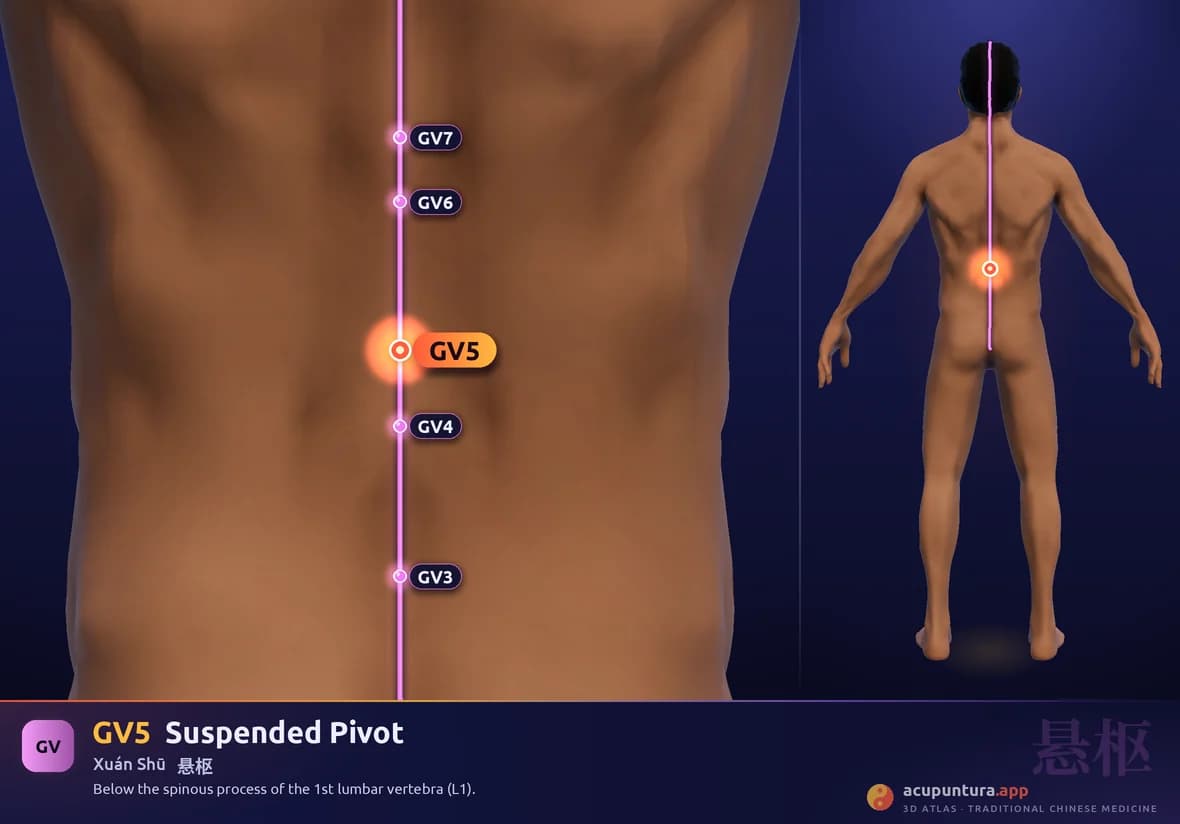
Du Mai (Governing Vessel) Channel
Suspended Pivot
悬枢Xuán ShūAnatomical location
Below the spinous process of the 1st lumbar vertebra (L1).
Main function
Regulates the Spleen and Stomach, strengthens the lumbar region.
Therapeutic indications
- Low back pain
- diarrhea
- abdominal distension
- rectal prolapse
- Low back pain
- Lumbar stiffness
- Indigestion
- Abdominal pain
Name and classical tradition
Xuanshu, 悬枢, is the “suspended pivot.” 悬 (懸) means to hang or suspend, and also to connect; 枢 (樞) is the pivot, the hinge. One reading explains it by position: above it lies GV7, Zhongshu, the “central pivot,” and this point, below, would be the suspended pivot joining the upper and lower parts of the spine. Another reading, in the modern Qi-water style, describes it as the place that receives the Dampness from GV4 and GV6 and distributes it like a vapor hanging from the sky. Both are modern glosses.
The sources attribute it to the Zhenjiu Jiayi Jing (Systematic Classic of Acupuncture and Moxibustion), with no verbatim quotation, and no well-attested alternative names are known for it. It lies below the first lumbar vertebra.