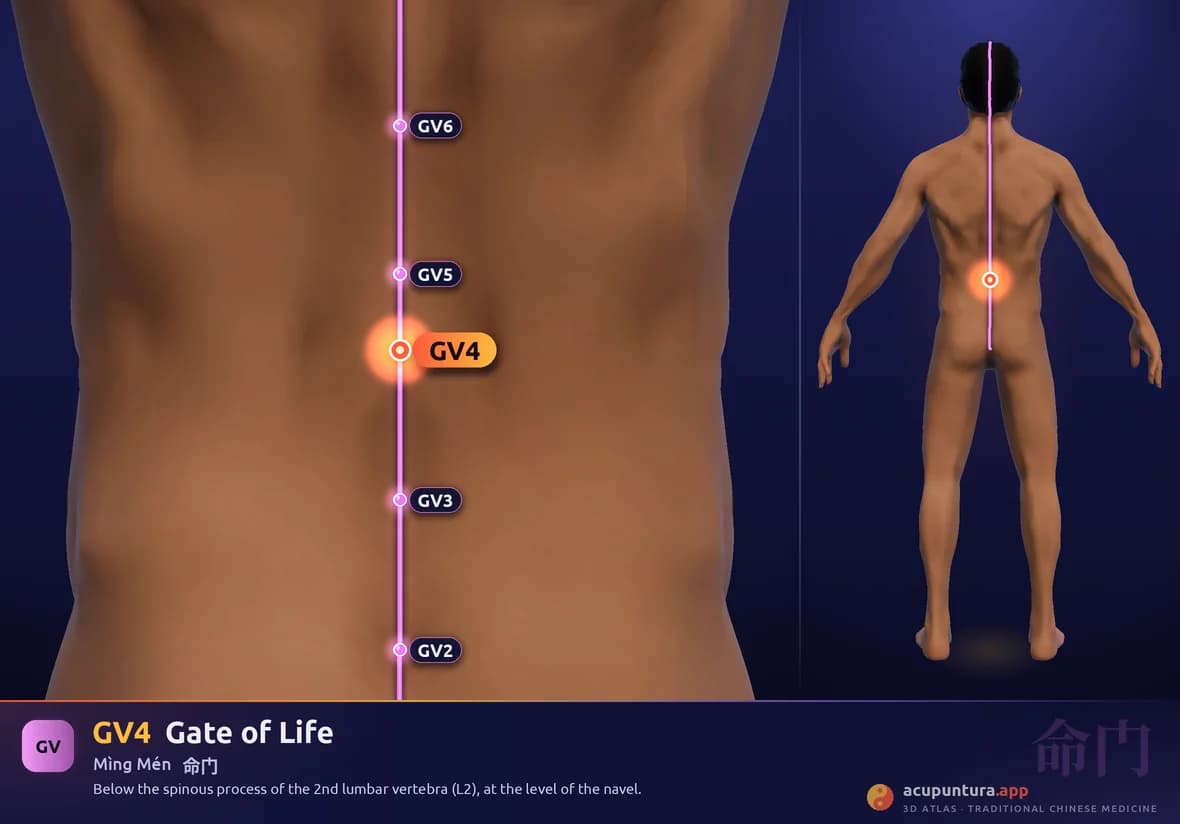
Du Mai (Governing Vessel) Channel
Gate of Life
命门Mìng MénAnatomical location
Below the spinous process of the 2nd lumbar vertebra (L2), at the level of the navel.
Main function
Strengthens Kidney Yang, benefits the spine, regulates the uterus.
- Crossing point with the Kidney
Therapeutic indications
- Low back pain
- impotence
- infertility
- fatigue
- weak knees
- Chronic low back pain
- Lumbar stiffness
- Nocturnal emission
- Leukorrhea
- Irregular menstruation
- Chronic diarrhea
- Exhaustion
- Cold extremities
- Tinnitus
- Cognitive decline and dementia
- Multiple sclerosis (Wei syndrome)
- Hypothyroidism
- Lumbar disc herniation
- Ankylosing spondylitis
- Osteoporosis
- Leukopenia from chemotherapy
Name and classical tradition
Mingmen, 命门, the “gate of life,” carries behind it one of the richest conceptual histories in Chinese medicine, and it helps to keep the history of the idea separate from that of the point.
In the Neijing (Inner Classic), 命門 did not designate anything on the back. The Lingshu (Spiritual Pivot), in the chapter Gen Jie (根結), says so unambiguously: “命門者,目也,” the gate of life is the eyes. It was the Nanjing (Classic of Difficulties), in Difficulty 36, that moved the term to the right Kidney and gave it its physiological meaning: “命門者,諸神精之所捨,原氣之所繫也。故男子以藏精,女子以系胞.” The gate of life is the dwelling place of the spirits and essences, to which the Original Qi is tied; in men it stores essence, and in women it holds the uterus. The doctrine kept evolving after that. Zhu Hong, in the Song period, placed the gate of life in the right kidney in men and the left in women; Yu Tuan, in the Ming period, used the name for both kidneys together. Sun Yikui and Zhao Xianke, the author of the Yiguan, placed it between the two kidneys, as the taiji of the body, and that formulation gave rise to the doctrine of the fire of the gate of life (命門之火), the root of Yang throughout the whole organism.
The acupuncture point is something else: a specific spot on the spine, below the second lumbar vertebra, between the two Kidney Shu points, BL23. Its name makes sense in light of that doctrine, but the history of the concept and the history of the point are not the same. It is also worth not confusing it with CV5, Shimen, on the Ren Mai, which some early physicians also called 命門. The Zhenjiu Jiayi Jing (Systematic Classic of Acupuncture and Moxibustion) records it as follows: “命門,一名屬累,在十四椎節下間,” also called Shulei, below the fourteenth vertebra. The reference works add 竹杖 and 精宮.
Other names
- 屬累Jiayi Jing