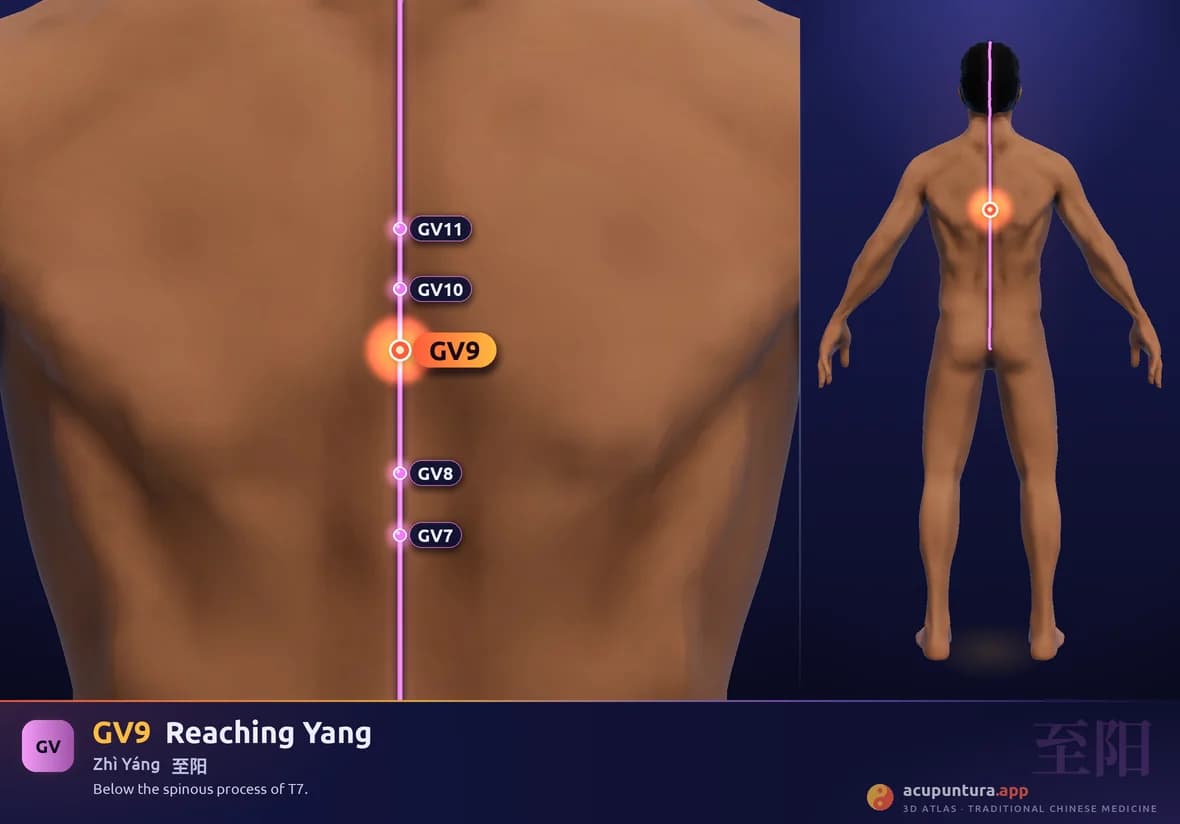
Du Mai (Governing Vessel) Channel
Reaching Yang
至阳Zhì YángAnatomical location
Below the spinous process of T7.
Main function
Regulates the Liver and Gallbladder, strengthens the spine.
Therapeutic indications
- Chest pain
- jaundice
- cough
- back pain
- Chest and rib-side pain
- Asthma
- Stiffness of the back
- Gastric pain
- Cholecystitis
Name and classical tradition
Zhiyang, 至阳, means “extreme yang.” 至 is the utmost, the extreme. The explanation the sources give is one of accumulation: the back is yang; the number seven is yang, and the point lies below the seventh thoracic vertebra. It would thus be yang within yang, at its highest degree. It is also linked to its position at the level of the diaphragm, where the spine passes from the upper thoracic region to the rest.
The Zhenjiu Jiayi Jing (Systematic Classic of Acupuncture and Moxibustion) locates it “在第七椎節下間,” in the space below the seventh vertebra, and assigns it indications that have survived: “寒熱懈懶,淫濼脛酸,四肢重痛,少氣難言,至陽主之.” Chills and fever with listlessness, tingling and weakness of the legs, heaviness and pain in the four limbs, shortness of breath and difficulty speaking: Zhiyang takes care of all of these.
The reference works give it the alternative name 肺底, “base of the Lung.” At its level, on both sides, lies BL17, Geshu.