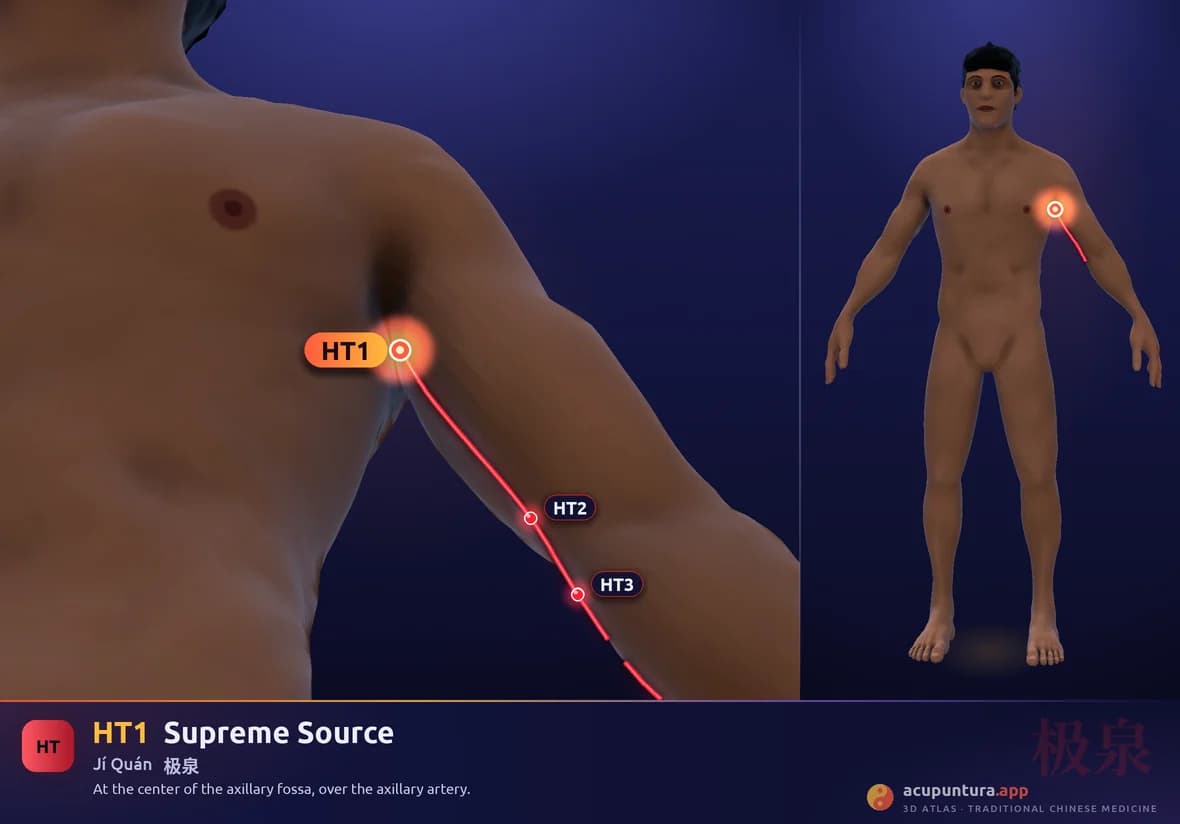
Heart Channel
Supreme Source
极泉Jí QuánAnatomical location
At the center of the axillary fossa, over the axillary artery.
Main function
Regulates Heart Qi, calms the Shen, relieves chest pain.
Therapeutic indications
- Chest pain
- palpitations
- arm pain
- insomnia
- inability to raise the arm
- dry throat
- sadness
- excessive axillary sweating
- axillary scrofula
- jaundice
- hypochondriac pain
Name and classical tradition
Jiquan, 极泉, is the “highest spring.” 极 (極) means the extreme, the highest; 泉, the spring, the place where water begins to well up. The point sits at the apex of the axilla, over the pulse of the axillary artery, and is the first and highest point of the Heart channel: from here the Qi of the hand Shaoyin wells up toward the hand like water from a spring.
Popular sources add a more ambitious reading, one that plays on another sense of 極, the throne, the supreme position. In the Suwen (Basic Questions) the Heart is the “sovereign” (君主之官), and the highest point of its channel would be the sovereign ascending the throne, “如君登極.” The image is evocative, but no ancient commentator supports it, and it should be taken as a modern interpretation.
The textual history of Jiquan, and of the whole channel, has a peculiarity. In the Ben Shu chapter, the Lingshu (Spiritual Pivot) lists the transport points of the other channels, but not those of the Heart. The reason is given in the Xie Ke (邪客) chapter: the Heart is “五臟六腑之大主也,精神之所舍也,其臟堅固,邪弗能容也,” the great lord of the organs and viscera, the dwelling of the spirit, so solid that no pathogen can lodge in it. The ailments that seem to belong to the Heart are actually in its envelope, the Pericardium channel, and for that reason the Heart channel “獨無俞,” is the only one without transport points. As a result, the first work to record Jiquan by name is Huangfu Mi’s Zhenjiu Jiayi Jing (Systematic Classic of Acupuncture and Moxibustion), in the third century, and not the Lingshu.