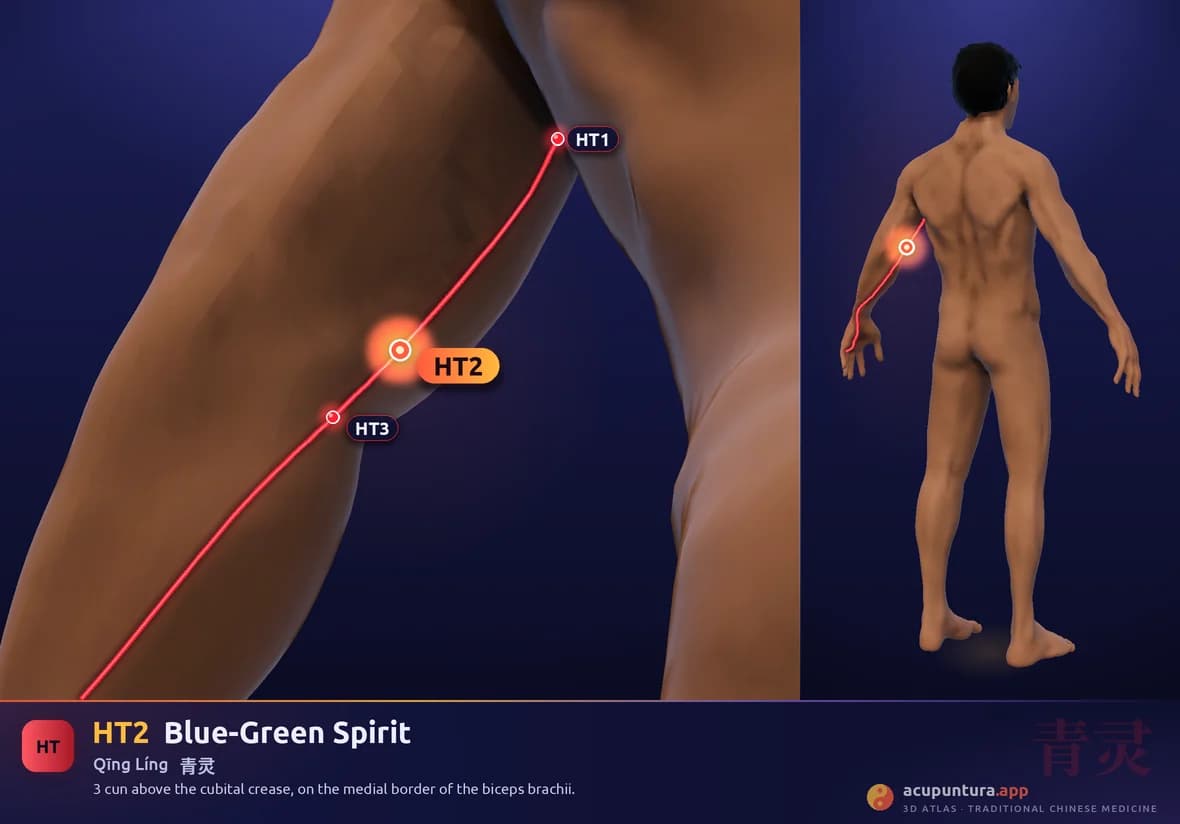
Heart Channel
Blue-Green Spirit
青灵Qīng LíngAnatomical location
3 cun above the cubital crease, on the medial border of the biceps brachii.
Main function
Clears Heat, relieves pain in the arm and shoulder.
Therapeutic indications
- Arm pain
- headache
- jaundice
- chest pain
- inability to lift the arm
- chills
- hypochondriac pain
- blurred vision
Name and classical tradition
Qingling, 青灵, is usually translated as “green spirit” or “spirit of the sprout.” 青 is the color of what is germinating; 灵 (靈), the spirit, the efficacious. One modern gloss links it to the Heart, which houses the spirit, and sees the point as the place where the channel’s Qi sprouts. Another, recorded in the Jingxueming Qianjie (A Plain Explanation of Point Names), reads it in a practical way: “灵指效验,青主痛症,” 靈 is efficacy and 青 alludes to pain, so the name would indicate a point effective against shoulder and arm pain. Both are late glosses.
The most interesting hypothesis comes from philology. An academic article published in 2009 in the journal Yixue yu Zhexue (Medicine and Philosophy) proposes that 青靈 is a corrupted form of an ancient name, 清冷淵, “clear and cold abyss,” which the Zhenjiu Jiayi Jing (Systematic Classic of Acupuncture and Moxibustion) and the two works of Sun Simiao record. During the Tang dynasty, the character 淵 was taboo because it matched the name of the founding emperor, Li Yuan (李淵), the same taboo that turned LU9, Taiyuan, into 大泉. Substitution and loss of characters would have led from 清冷淵 to 青靈泉 and finally to 青靈. The hypothesis has not been verified against the original article, and it should be treated as such.
If it were true, it would force us to distinguish carefully between two points. 清冷淵 is today the name of TE11, Qinglengyuan, on the Triple Energizer channel, a different point from Qingling. The textual origin of Qingling is also disputed: secondary sources trace it to the Zhenjiu Jiayi Jing, while another reference places the first appearance of the spelling 青靈 in the Taiping Shenghui Fang (Taiping Imperial Grace Formulary), from the Song period.