Kidney Channel
Great Bell
大钟DàzhōngAnatomical location
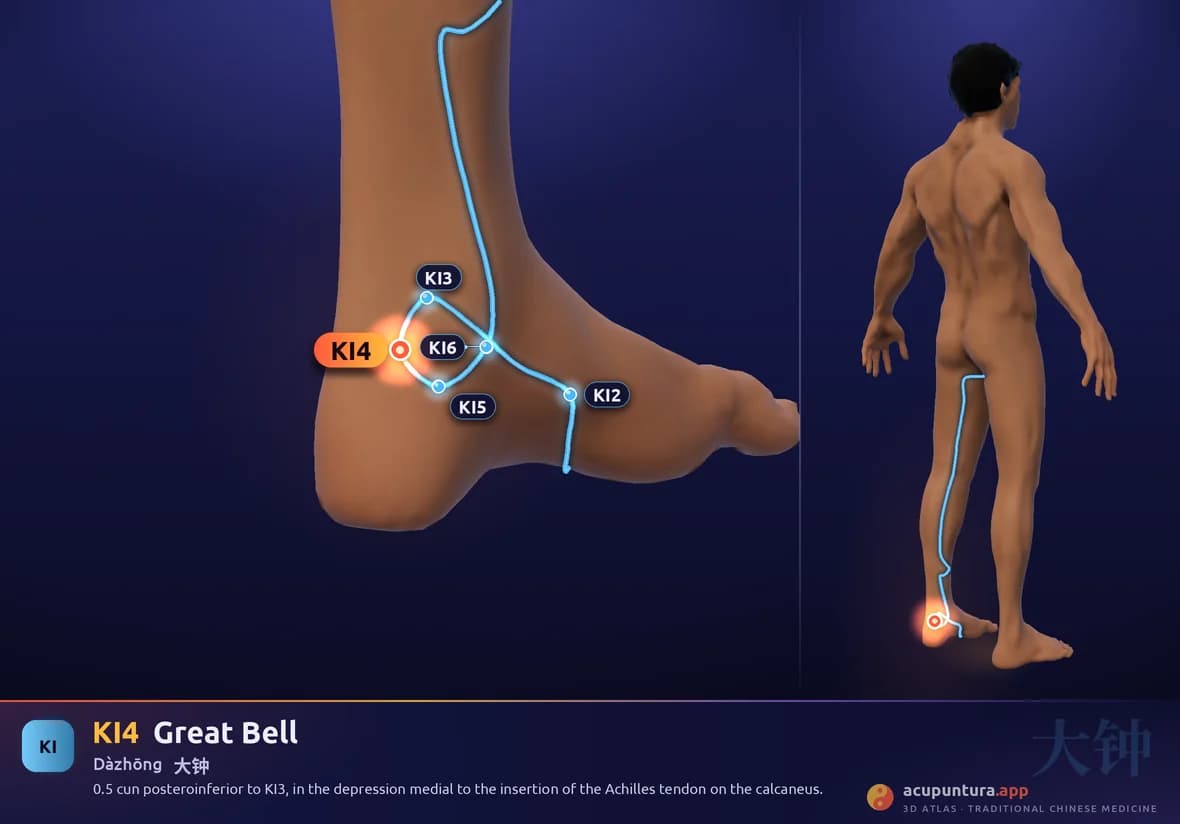
0.5 cun posteroinferior to KI3, in the depression medial to the insertion of the Achilles tendon on the calcaneus.
Main function
Regulates Kidney Qi, strengthens the lumbar region, benefits the Lower Jiao, calms the Shen, and treats throat disorders.
- Luo (Connecting) point
- Crossing Point with the Bladder
Therapeutic indications
- Low back pain
- leg weakness
- enuresis
- urinary incontinence
- dysuria
- sore throat
- loss of voice
- anxiety
- insomnia
- urinary retention
- constipation
- heel pain
- asthma
- hemoptysis
- memory impairment
- fear
- somnolence
Name and classical tradition
Dazhong, 大钟, is the “great bell.” 大 is great; 钟 (鍾) is the bell. Some also read it as 踵, the heel, which is pronounced the same and fits better with its location, next to the insertion of the Achilles tendon. The sources consulted don't develop the analysis further, and neither reading has an ancient author behind it.
As a Luo-Connecting point (絡穴), Dazhong does not appear in the Ben Shu chapter but in the Jing Mai (經脈) chapter of the Lingshu (Spiritual Pivot), the one that lists the collaterals: “足少陰之別,名曰大鍾,當踝後繞跟,別走太陽”. The collateral of the foot Shaoyin is called Dazhong; it lies behind the ankle, encircles the heel, and diverges toward the Taiyang. The phrase “繞跟,” encircles the heel, lends some support to reading 鍾 as 踵. Dazhong is the point that connects the Kidney channel with the Bladder channel, its paired channel.