Kidney Channel
Great Ravine
太溪TàixīAnatomical location
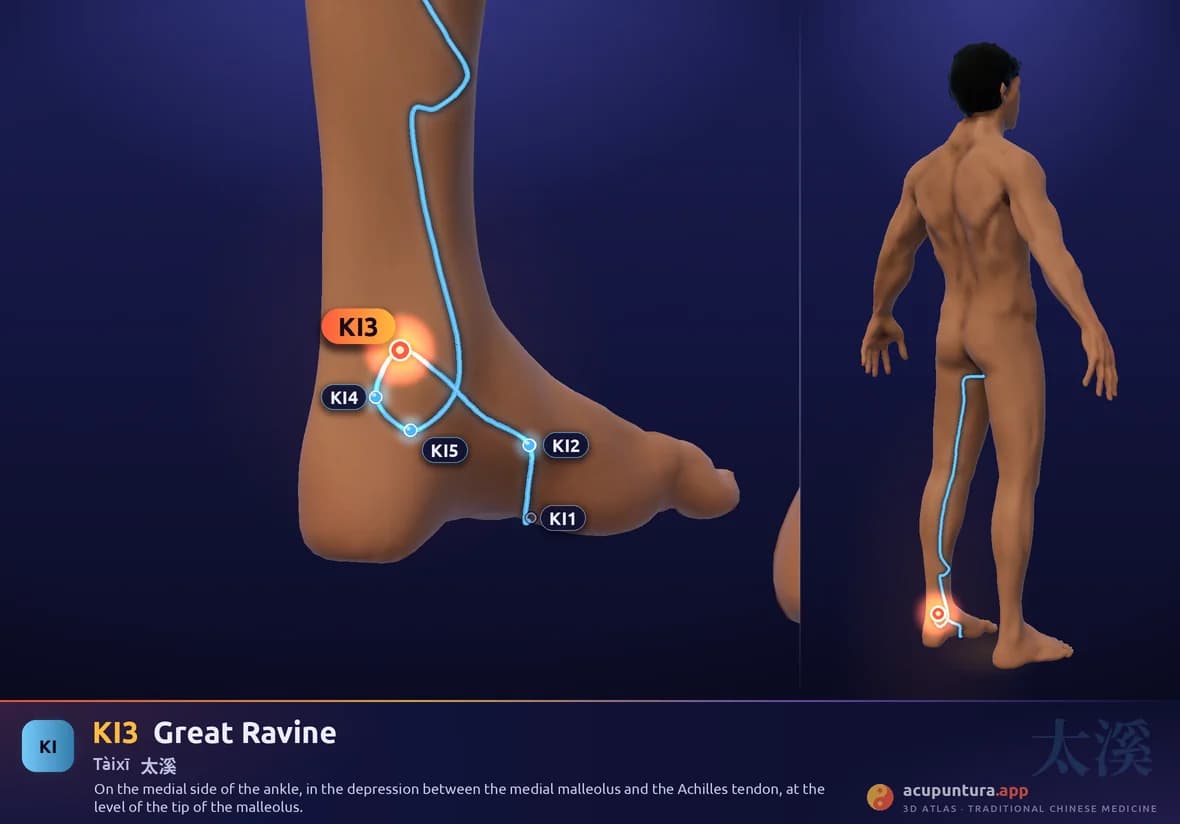
On the medial side of the ankle, in the depression between the medial malleolus and the Achilles tendon, at the level of the tip of the malleolus.
Main function
Tonifies Kidney Yin and Yang, nourishes the Jing, strengthens the lumbar region, regulates urination, benefits the Lower Jiao, and calms the Shen.
- Yuan (Source) point
- Shu-Stream point (Earth)
- Ryodoraku point F3 (Kidney)
Therapeutic indications
- Low back pain
- leg weakness
- enuresis
- urinary incontinence
- dysuria
- impotence
- infertility
- dysmenorrhea
- tinnitus
- deafness
- insomnia
- anxiety
- afternoon fever
- Chronic low back pain
- Tinnitus
- Dizziness
- Hot flashes
- Night sweats
- Dry throat
- Chronic asthma
- Chronic cough
- Nocturnal emission
- Menstrual irregularity
- Urinary frequency
- Constipation
- Heel pain
- Weak knees
- Cognitive decline and dementia
- Parkinson's disease (tremor due to Internal Wind)
- Multiple sclerosis (Wei syndrome)
- Ménière's disease
- Diabetes mellitus (Xiao Ke)
- Hypothyroidism
- Hyperthyroidism
- COPD and chronic bronchitis
- Prostatitis and benign prostatic hyperplasia
- Knee osteoarthritis
- Osteoporosis
- Plantar fasciitis
- Alopecia areata
Ryodoraku
F3RiñónMeasurement point no. 8
Yuan-Source point of the Kidney, between the medial malleolus and the Achilles tendon.
Name and classical tradition
Taixi, 太溪, is the “great stream.” 太 means great or supreme; 溪 is a stream, the narrow channel running between ridges. The point sits in the depression between the medial malleolus and the Achilles tendon, and the modern gloss reads it as the place where the channel's Qi has already become a sizable stream. The Lingshu (Spiritual Pivot), in the chapter Ben Shu (本輸), locates it this way: “注於太谿,太谿內踝之後,跟骨之上陷中者也,為俞”. The Qi pours into Taixi, behind the medial malleolus, above the calcaneus, in the depression; it is the Shu-Stream point.
On the Yin channels, the Shu-Stream point (輸穴) is also the Yuan-Source point (原穴) and corresponds to Earth. 太 is shared with the other Yuan-Source points of the Yin organs, such as LU9, Taiyuan; SP3, Taibai; or LR3, Taichong.
Its alternative names are interesting. 大溪 is a graphic variant. 呂細 would point to the twelve pitches (十二律呂) of ancient music. And 內昆侖, “inner Kunlun,” pairs it with BL60, Kunlun, which lies on the opposite side of the same ankle, behind the lateral malleolus. These aliases are known in the modern literature, but they have not been verified in the Zhenjiu Jiayi Jing (Systematic Classic of Acupuncture and Moxibustion) or the Zhenjiu Dacheng (Great Compendium of Acupuncture and Moxibustion).