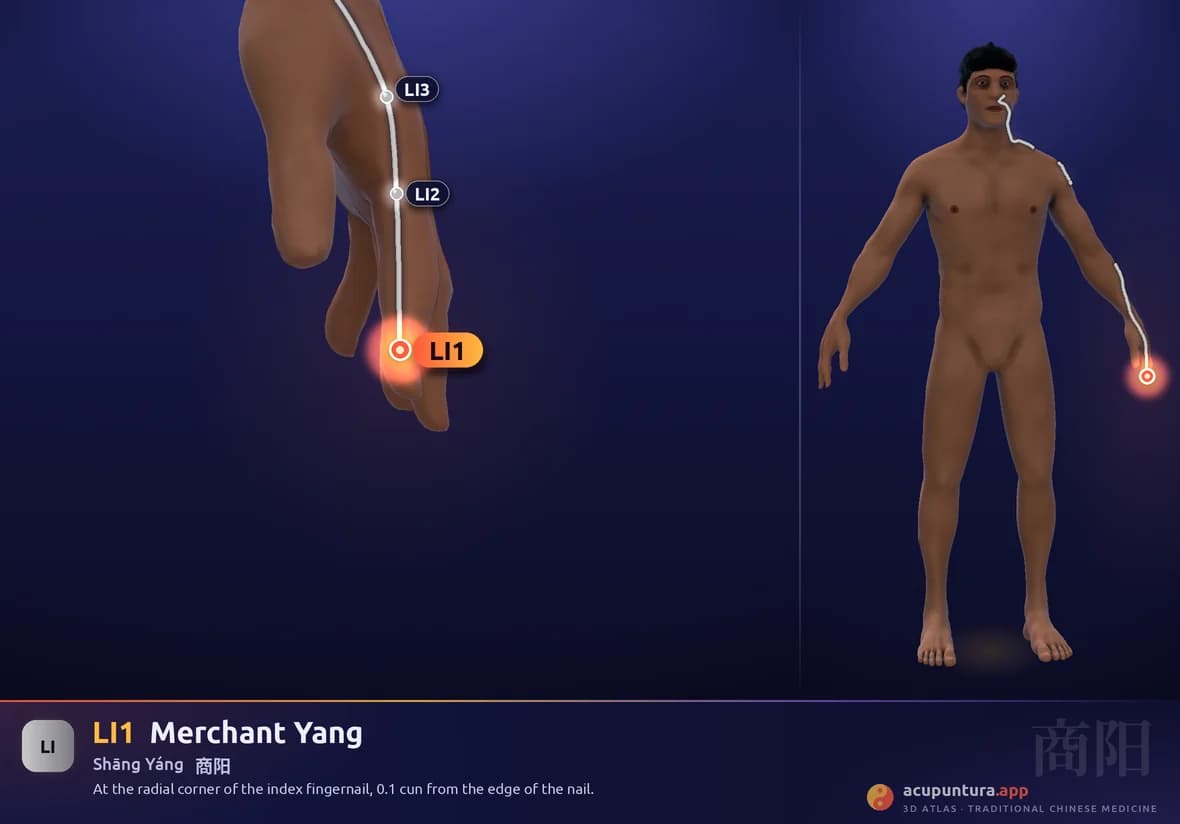
Large Intestine Channel
Merchant Yang
商阳Shāng YángAnatomical location
At the radial corner of the index fingernail, 0.1 cun from the edge of the nail.
Main function
Clears Heat, benefits the throat, relieves pain.
- Jing-Well point (Metal)
Therapeutic indications
- Sore throat
- toothache
- fever
- tinnitus
- High fever
- Loss of consciousness
- Numbness of the index finger
- Deafness
- Jaw pain
- Dry mouth
- Stroke sequelae
Name and classical tradition
Shangyang, 商陽, opens the Large Intestine channel at the tip of the index finger, right where the Lung channel ends. Its name echoes the last point of that channel, LU11, Shaoshang: both carry 商, the note of the classical pentatonic scale (宮商角徵羽) that Five Phases theory associates with Metal. If Shaoshang is the “lesser Shang” of the Yin channel, Shangyang is the “Yang Shang,” the same Metal note carried over to the coupled Yang channel. This is the standard reading, consistent with the system of the Neijing itself, although no ancient commentator writes it down for this point.
In the Ben Shu chapter (本輸), the Lingshu (Spiritual Pivot) opens the channel's series with it: «大腸上合手陽明,出於商陽,商陽,大指次指之端也,為井金». The Large Intestine joins above with hand Yangming; its Qi emerges at Shangyang, at the tip of the finger next to the thumb; it is the Jing-Well point, of Metal nature. Unlike the Yin channels, whose first point is Wood, in the Yang channels the Jing-Well point corresponds to Metal, and here it coincides with the phase of the channel itself.
The Zhenjiu Jiayi Jing (Systematic Classic of Acupuncture and Moxibustion) already gives it the alternative name 絕陽, “extreme Yang” or “severed Yang.”
Other names
- 絕陽Jiayi Jing