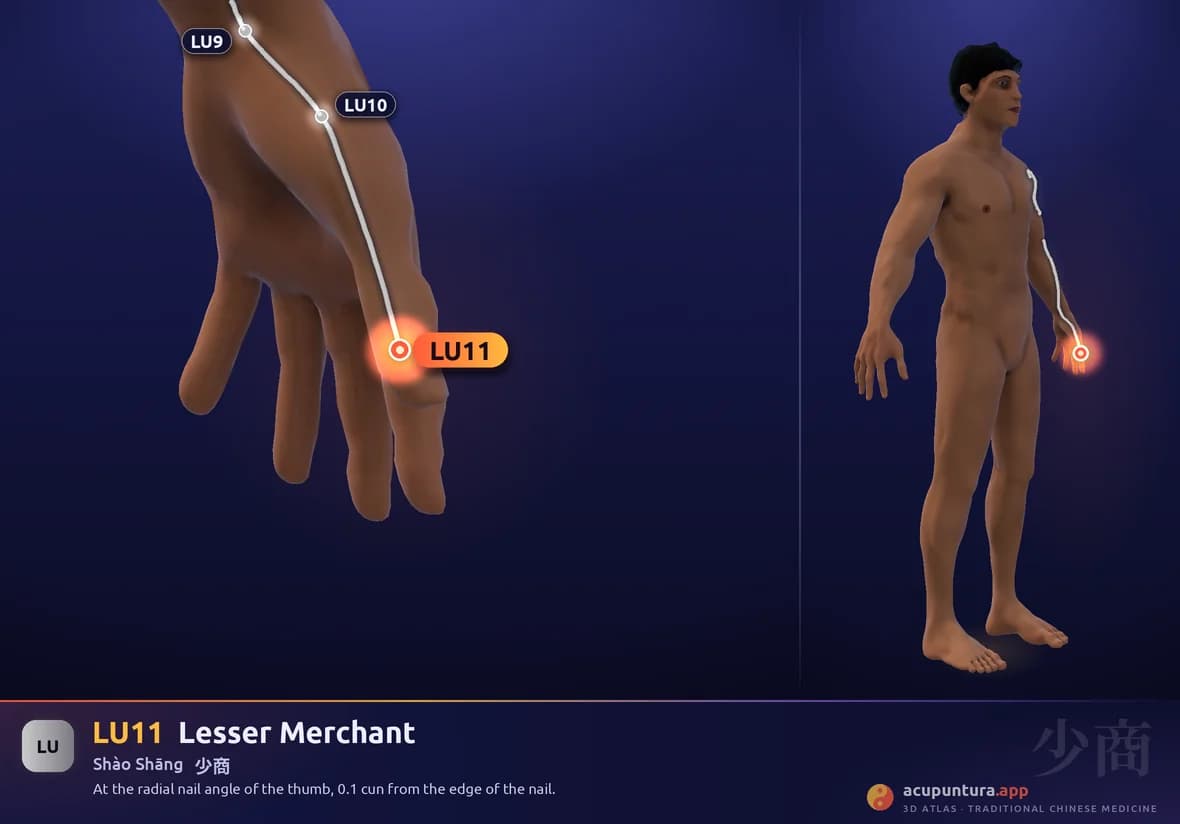
Lung Channel
Lesser Merchant
少商Shào ShāngAnatomical location
At the radial nail angle of the thumb, 0.1 cun from the edge of the nail.
Main function
Clears Heat, restores consciousness, benefits the throat.
- Jing-Well point (Wood)
Therapeutic indications
- Sore throat
- cough
- fever
- loss of consciousness
- acute tonsillitis
- high fever
- epistaxis
- heatstroke
- infantile convulsions
- mumps
- mania
- numbness of the thumb
- schizophrenia (Dian Kuang)
- acute psychosis
Name and classical tradition
Shaoshang, 少商, is the point where the Lung channel ends at the tip of the thumb, and its name is musical. 商 is one of the five notes of the classical pentatonic scale (宮商角徵羽), the one that Five Phases cosmology assigns to Metal and, by extension, to the Lung. 少 means «small» or «young,» in contrast with 大, «great.» The usual reading takes the name as the note of the Lung in its faintest expression: at this extremity of the body Qi barely emerges, before growing along the channel.
The Lingshu (Spiritual Pivot), in the Ben Shu chapter (本輸), leaves a complete definition: «肺出於少商,少商者,手大指端內側也,為井木». Lung Qi emerges at Shaoshang, which lies on the inner side of the tip of the thumb, and it is the Jing-Well point (井穴), Wood in nature. This detail matters, because the element of the point does not match that of the channel: on the Yin channels, the first transport point is always Wood, even if the channel belongs to Metal. From here, the sequence of the five points continues through LU10, LU9, LU8, and LU5.
The Zhenjiu Jiayi Jing (Systematic Classic of Acupuncture and Moxibustion) offers a homely measurement: the point lies a chive leaf's width from the corner of the nail, «去爪甲角如韭葉». The Waitai Miyao, from the Tang period, repeats the reference and places it at the edge of the white flesh, in a small hollow. In Chinese clinical practice, Shaoshang has for centuries been tied to bloodletting by pricking (點刺放血) in Heat patterns, inflamed throat, loss of voice, or infantile convulsions. The use is well attested, although it is not known with certainty which author or work first established it.
In Sun Simiao's Qianjin Yaofang (Essential Prescriptions Worth a Thousand Gold), the second of the thirteen ghost points is needled «手大指爪甲下,名鬼信», under the nail of the thumb, and is called Guixin, «messenger of the ghosts.» It is the location of Shaoshang, although the text does not give the name of the point.