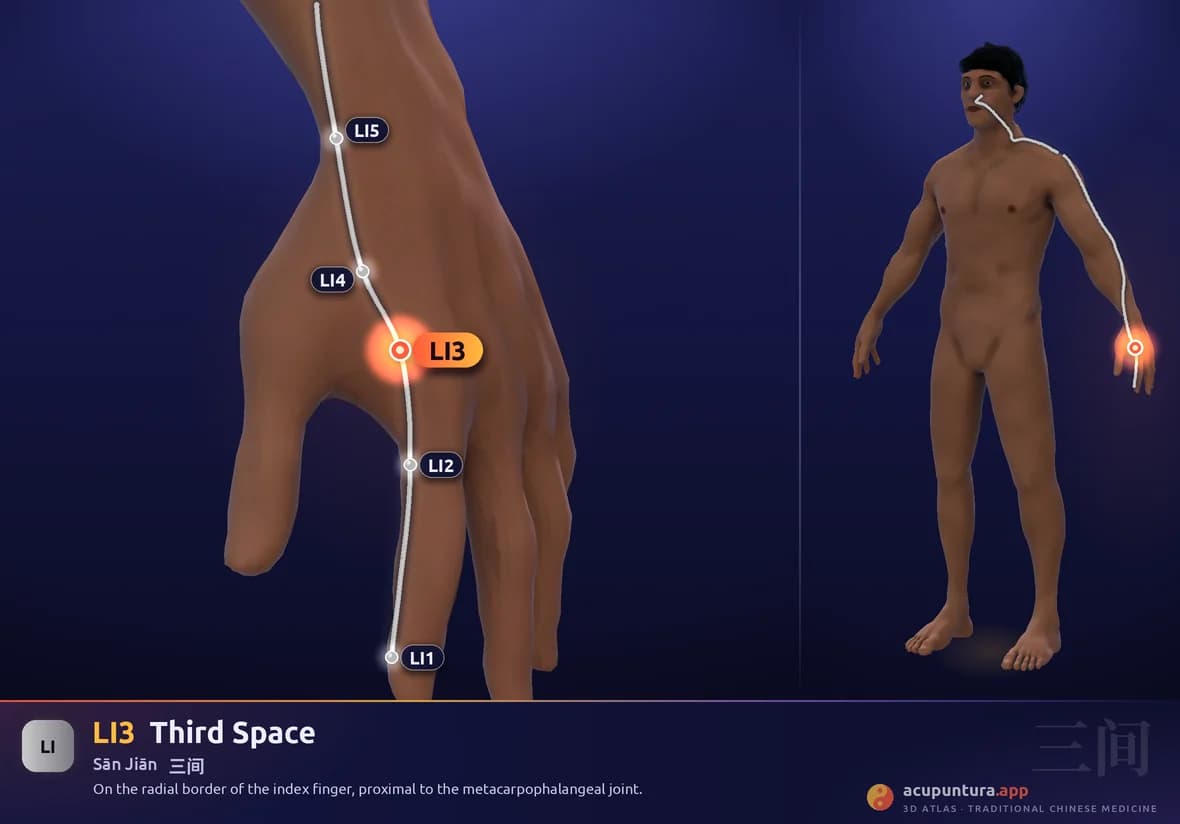
Large Intestine Channel
Third Space
三间Sān JiānAnatomical location
On the radial border of the index finger, proximal to the metacarpophalangeal joint.
Main function
Clears Heat, regulates the Large Intestine, relieves pain.
- Shu-Stream point (Wood)
Therapeutic indications
- Sore throat
- abdominal pain
- diarrhea
- fever
- swelling of the back of the hand and fingers
- borborygmi
- eye pain
- drowsiness
- toothache
- stiff fingers
Name and classical tradition
Sanjian, 三間, is the “third interval.” It continues the numbering that begins at LI2: if Erjian lies in front of the joint at the base of the index finger, Sanjian lies behind it, in the next hollow. The two names work as an anatomical counter running along the finger from the fingertip toward the hand.
The Lingshu (Spiritual Pivot), chapter Ben Shu (本輸), records it this way: “注於本節之後三間,為俞.” The qi pours into Sanjian, behind the joint; it is the Shu-Stream point (輸穴). On the yang channels, the Shu-Stream point corresponds to Wood. The verb changes with each point in the sequence, from the “sliding” of Erjian to the “pouring” of Sanjian, and it is usually read as the image of a current that grows as the qi advances toward the elbow.
Modern references give it two alternative names, 少谷, “lesser valley,” and 少骨, “small bone,” which sound almost identical; the first already appears in the Zhenjiu Jiayi Jing (Systematic Classic of Acupuncture and Moxibustion).
Other names
- 少谷Jiayi Jing