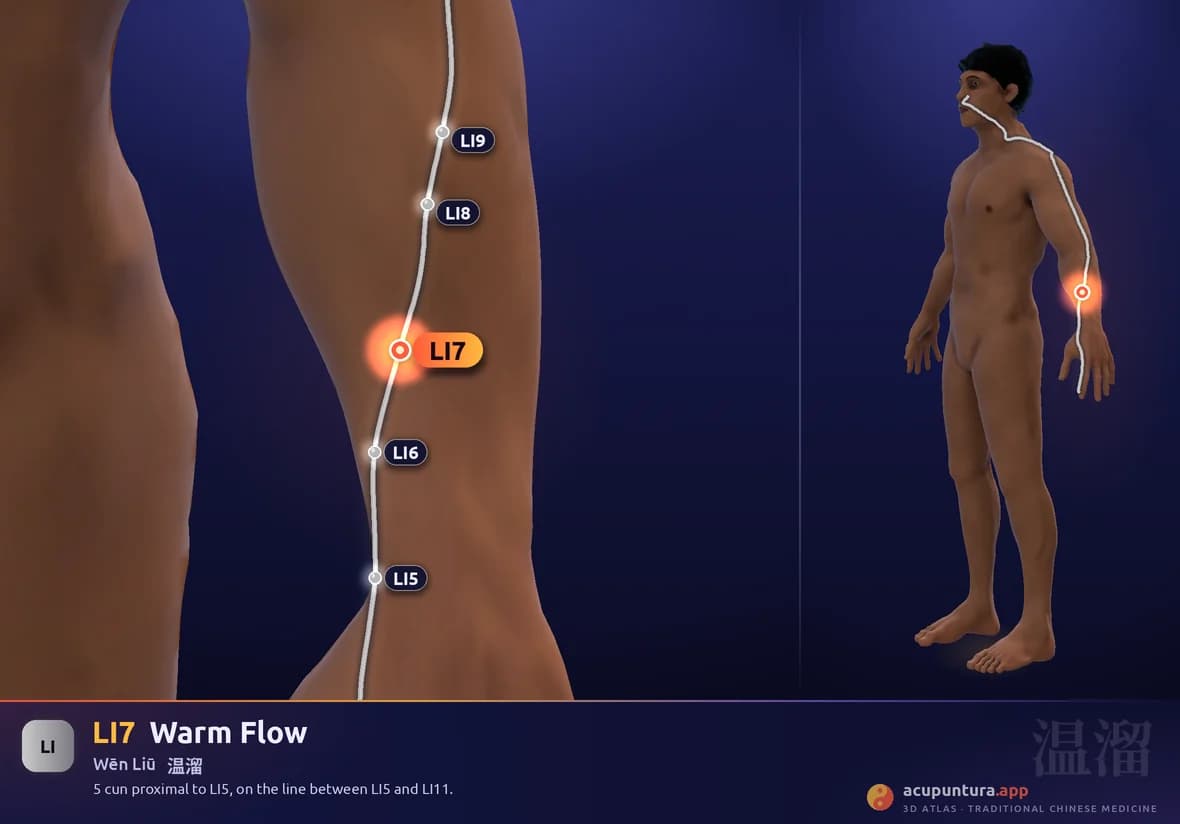
Large Intestine Channel
Warm Flow
温溜Wēn LiūAnatomical location
5 cun proximal to LI5, on the line between LI5 and LI11.
Main function
Clears Heat, regulates the Large Intestine, relieves pain.
- Xi-Cleft point
Therapeutic indications
- Sore throat
- abdominal pain
- diarrhea
- fever
- borborygmi
- boils
- shoulder and arm pain
- facial edema
- swollen tongue
- glossitis
- acute sore throat
Name and classical tradition
Wenliu, 溫溜, is the “warm flow.” 溫 means warm, mild; 溜, to flow, to glide. The explanation the manuals give is functional: the point warms the channel and gets it circulating, and it is used for cold-type pain in the elbow and forearm. It is a coherent reading, but a modern one, with no classical citation to support it. Wenliu is the Xi-Cleft point (郄穴) of the Large Intestine, the point of deep accumulation that the tradition reserves for acute conditions. The sources trace it to the Zhenjiu Jiayi Jing (Systematic Classic of Acupuncture and Moxibustion).
The most striking thing about this point is the number of alternative names it has accumulated: 蛇頭, “snake's head,” 逆注, 地頭, 通注, 池頭, and 溫留, the last a simple graphic variant. The snake name has a visual explanation: when the fist is clenched, the muscle bulge in that area stands out like a snake's head. It is a reasonable image, though its attribution is modern, and which of these aliases is the oldest remains to be established.
Other names
- 逆注Jiayi Jing
- 蛇頭Jiayi Jing