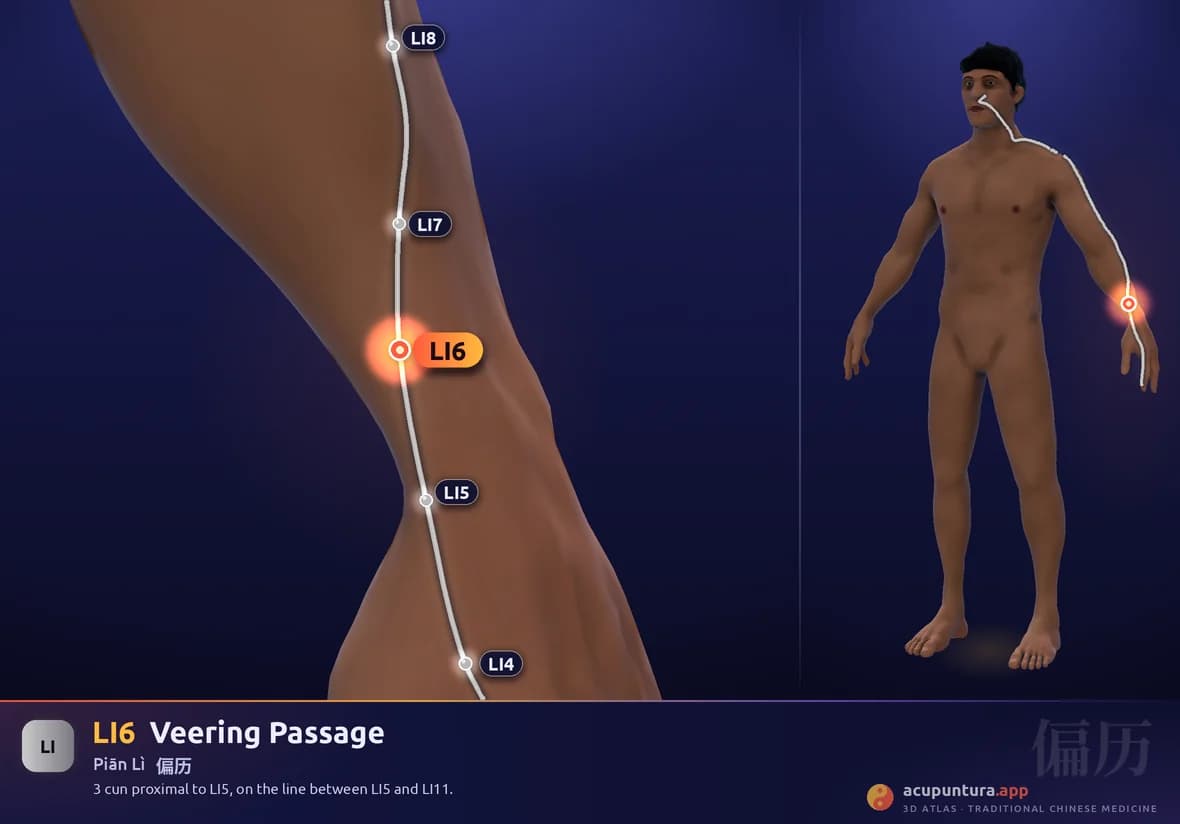
Large Intestine Channel
Veering Passage
偏历Piān LìAnatomical location
3 cun proximal to LI5, on the line between LI5 and LI11.
Main function
Disperses Wind-Heat, benefits the ears, regulates the Large Intestine.
- Luo (Connecting) point
Therapeutic indications
- Tinnitus
- sore throat
- forearm pain
- epistaxis
- deafness
- edema
- difficulty urinating
- forearm and wrist pain
- red eyes
- facial paralysis
- nosebleed
Name and classical tradition
Pianli, 偏歷, is best understood from its function. 偏 means to deviate, to go to one side; 歷, to pass through, to traverse. Pianli is the Luo-Connecting point (絡穴) of the Large Intestine: the place where a branch separates from the main pathway and passes to the paired channel, the Lung. The name describes that detour. This is the standard explanation and is consistent with the theory of the collaterals set out in the Lingshu (Spiritual Pivot), chapter Jing Mai, although it has not been confirmed that the chapter cites the point by name.
Like most points on the forearm of this channel, Pianli does not appear in the Ben Shu chapter. Its first documentable appearance is in the Zhenjiu Jiayi Jing (Systematic Classic of Acupuncture and Moxibustion) by Huangfu Mi, which cites it in two books of indications. In the one on fevers: “風瘧汗不出,偏歷主之,” intermittent fevers from wind without sweating. And in another: “善耳鳴,口僻頰腫,實則聾齲,喉痺不能言,齒痛,鼻鼽衄,虛則痺,鬲俞、偏歷主之,” ringing in the ears, deviated mouth, swollen cheek; in excess, deafness and dental caries, obstructed throat that prevents speech, toothache, and nosebleed; in deficiency, numbness. They are treated with Geshu and Pianli.