Liver Channel
Great Mound
大敦Dà DūnAnatomical location
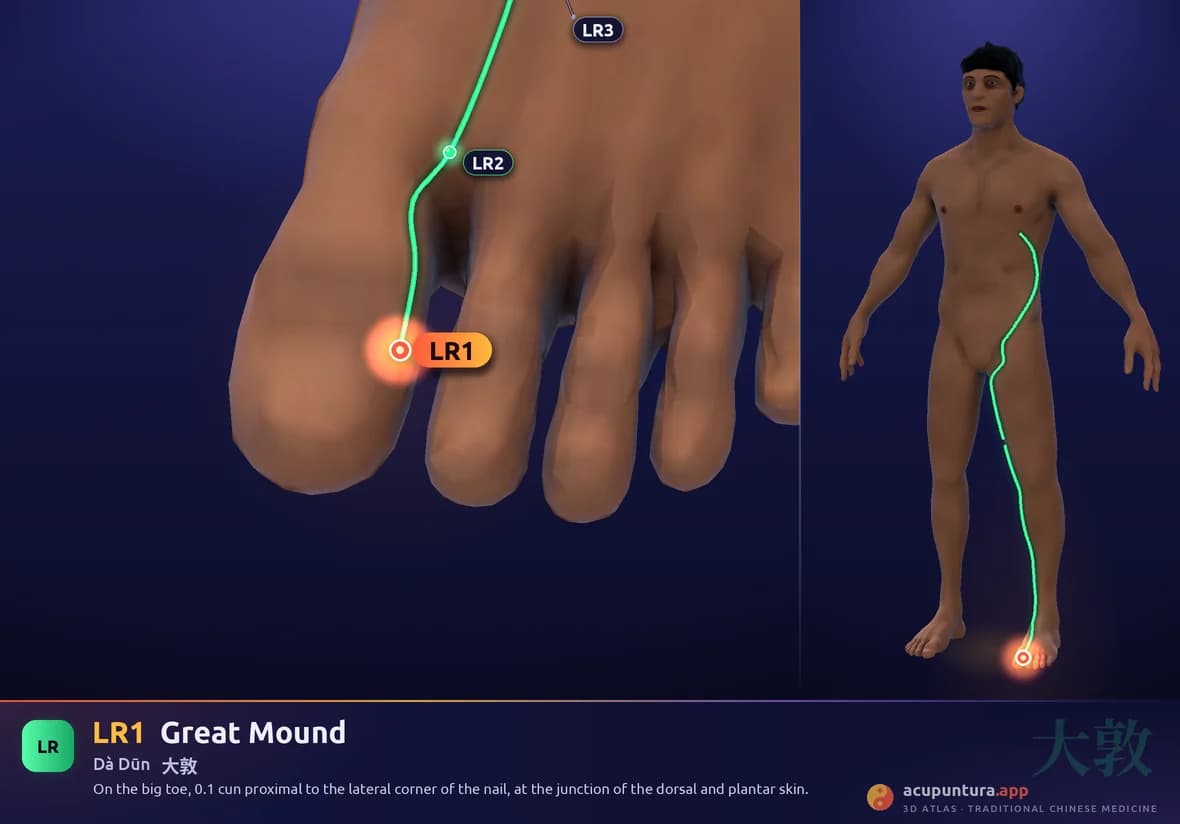
On the big toe, 0.1 cun proximal to the lateral corner of the nail, at the junction of the dorsal and plantar skin.
Main function
Jing-Well point (Wood), regulates the Liver, calms Internal Wind, benefits the genitals and the uterus, restores consciousness.
- Jing-Well point (Wood)
- Exit Point
Therapeutic indications
- Genital pain
- dysmenorrhea
- metrorrhagia
- uterine prolapse
- leukorrhea
- epilepsy
- headache
- vertigo
- Inguinal hernia
- Testicular pain and retraction
- Enuresis
- Dysuria
- Uterine bleeding
Name and classical tradition
Dadun (大敦) is the first point of the Liver channel, on the big toe. 大 is great; 敦, in this context, means thick, swollen, a mound. The accepted reading ties it to the fleshy swelling of the big toe where the point lies: the “great mound.” The character 敦 also has the sense of honest, sincere, and more abstract translations come from that, but the basis of the name appears to be anatomical.
The Lingshu (Spiritual Pivot), in the chapter Ben Shu (本輸), describes the five transport points of the channel in a single passage, which begins here: “肝出於大敦,大敦者,足大指之端及三毛之中也,為井木”. The Qi of the Liver emerges at Dadun, at the tip of the big toe, among the “three hairs”; it is the Jing-Well point, Wood in nature. The “three hairs” are the hair that grows over the joint of the toe, an anatomical reference very typical of the period. In this case, the Wood of the point matches that of the Liver itself.
The reference works record the alternative name 三毛, “three hairs,” which may be a real alias or simply the Lingshu's description turned into a name.