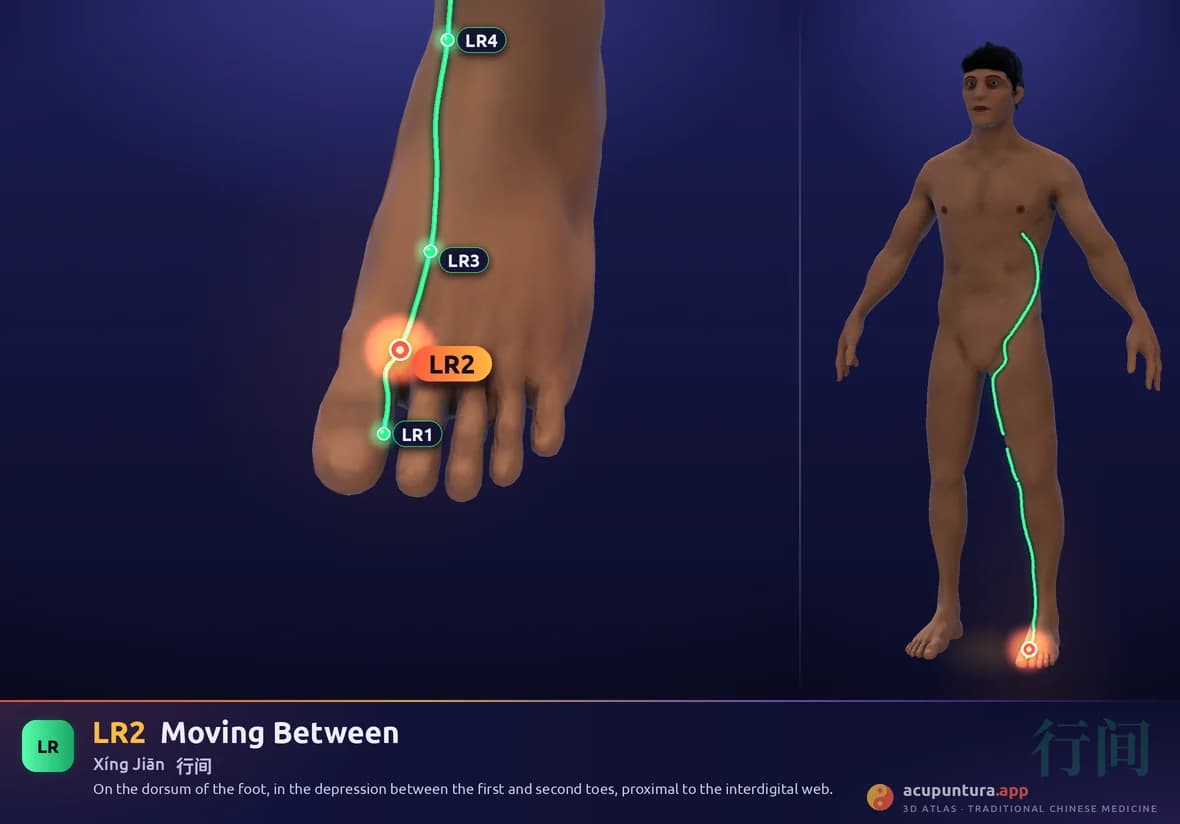
Liver Channel
Moving Between
行间Xíng JiānAnatomical location
On the dorsum of the foot, in the depression between the first and second toes, proximal to the interdigital web.
Main function
Ying-Spring point (Fire), sedation point, regulates the Liver, calms Internal Wind, cools the Blood, benefits the eyes.
- Ying-Spring Point (Fire)
- Sedation Point
Therapeutic indications
- Headache
- vertigo
- red eyes
- blurred vision
- metrorrhagia
- insomnia
- irritability
- hypertension
- Cephalalgia
- Red
- painful eyes
- Glaucoma
- Dysmenorrhea
- Dysuria
- Genital pain
- Epilepsy
- Convulsions
- Rib-side pain
- Bitter taste in the mouth
- Hernia
- Hyperuricemia and gout
- Hyperthyroidism
Ryodoraku
- Sedation of Liver
Name and classical tradition
Xingjian (行间) is the “passage between.” 行 means to walk, to circulate, to pass through; 间 (間), the space between two things. The Lingshu (Spiritual Pivot) itself confirms the literal reading when it locates the point: “溜於行間,行間,足大指間也,為滎”. Qi glides to Xingjian, between the toes of the foot; it is the Ying-Spring point. The point is at the commissure between the first and second toes, the space through which the channel's Qi passes. There is no need to resort to the modern gloss of turbid vapor rising.
It is the Ying-Spring point (滎穴) of the Liver, which on the Yin channels corresponds to Fire. No alternative names are known. Its immediate neighbor, two cun above, is LR3, Taichong.