Liver Channel
Wood Groove
蠡沟Lì GōuAnatomical location
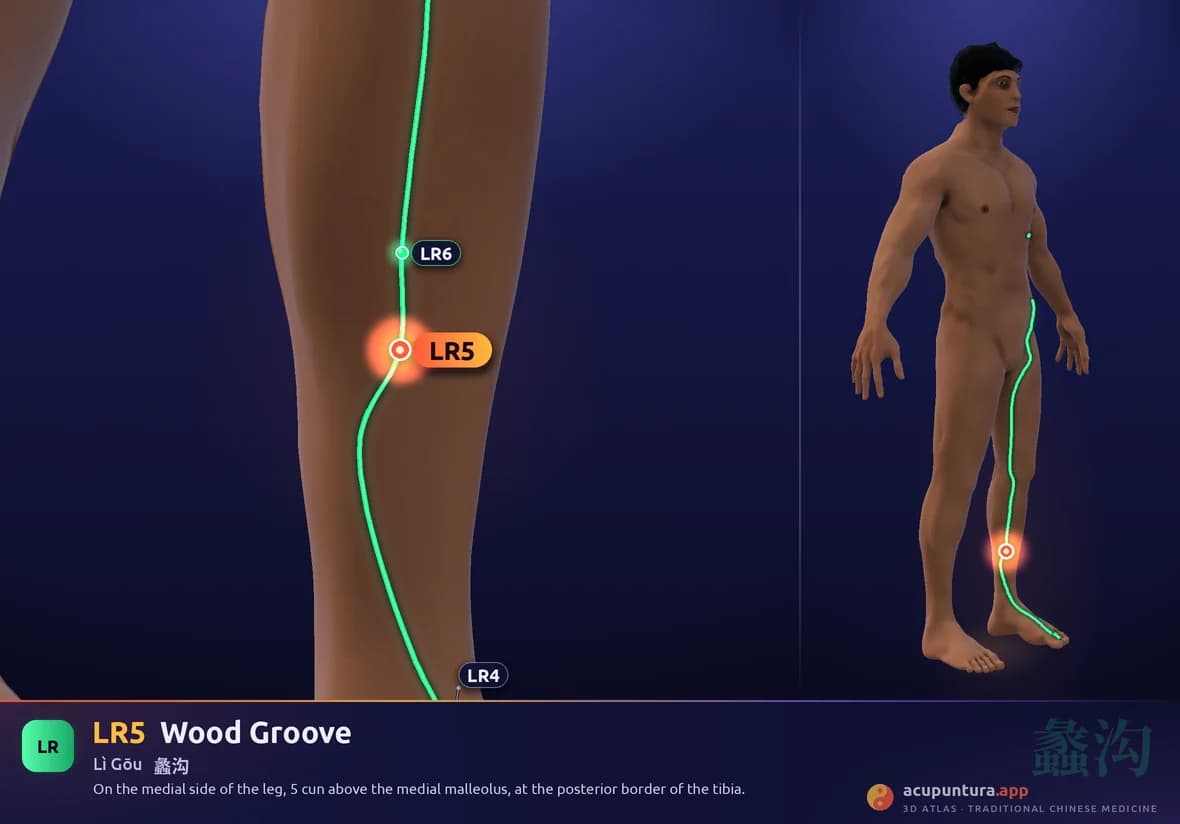
On the medial side of the leg, 5 cun above the medial malleolus, at the posterior border of the tibia.
Main function
Luo-Connecting point, regulates the Liver, benefits the Lower Jiao, resolves Dampness, regulates menstruation, calms genital itching.
- Luo (Connecting) point
Therapeutic indications
- Genital itching
- dysmenorrhea
- metrorrhagia
- leukorrhea
- urinary incontinence
- leg pain
- Menstrual irregularity
- Dysuria
- Hernia
- Pain in the leg
- Urinary retention
- Impotence
Name and classical tradition
Ligou (蠡沟) combines 沟 (溝), the furrow, the ditch, and 蠡, a character with two classical readings: the shell, the mollusk, and the woodworm, the insect that gnaws wood. The reading most repeated in the sources is anatomical: the muscle belly of the calf has the shape of a shell here, and the point lies in the furrow beside it. The translation “furrow of the wood” rests on the other meaning, that of the woodworm, which is less widespread. Both exist, and no ancient source decides between them.
What is fixed, however, is its function. The Lingshu (Spiritual Pivot), in the chapter Jing Mai (經脈), says: “足厥陰之別,名曰蠡溝。去內踝五寸,別走少陽;其別者,經脛上睪,結於莖。其病氣逆則睪腫卒疝。實則挺長,虛則暴癢。取之所別也”. The collateral of the foot Jueyin is called Ligou; it is five cun from the medial malleolus and diverges toward the Shaoyang; its branch rises along the leg to the testicles and knots at the penis. If the Qi reverses, there is testicular swelling and sudden hernia; in excess, persistent erection; in deficiency, sudden itching. It is treated at the point where it separates.
It is, then, the Luo-Connecting point (絡穴) of the Liver, the one that communicates with the Gallbladder, and the citation also explains the channel's relationship with the genitals. The reference works attribute to it the alternative name 交儀.