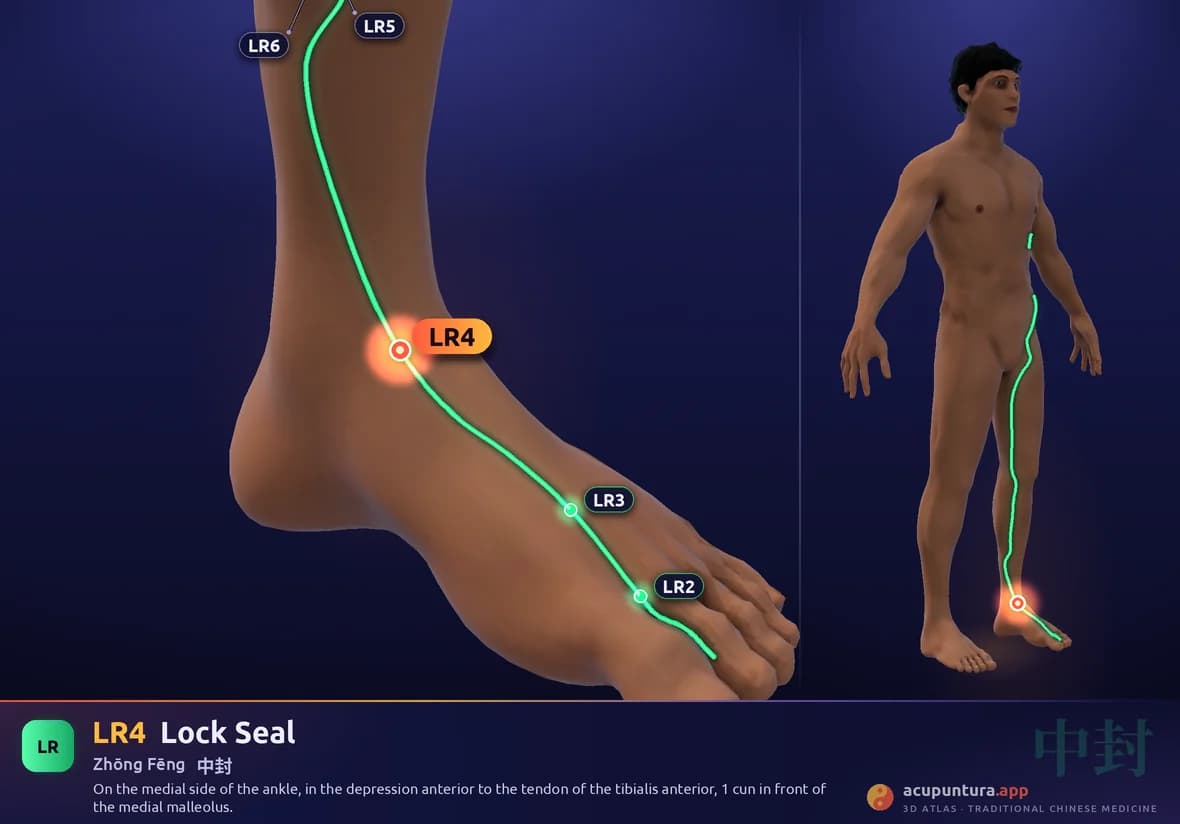
Liver Channel
Lock Seal
中封Zhōng FēngAnatomical location
On the medial side of the ankle, in the depression anterior to the tendon of the tibialis anterior, 1 cun in front of the medial malleolus.
Main function
Jing-River point (Metal), regulates the Liver, benefits the genitals, resolves Dampness, regulates urination.
- Jing-River point (Metal)
Therapeutic indications
- Ankle pain
- dysuria
- urinary incontinence
- genital pain
- leukorrhea
- abdominal pain
- edema
- Hernia
- Urinary retention
- Jaundice
- Ankle pain and stiffness
- Involuntary ejaculation
- Hypogastric pain
Name and classical tradition
Zhongfeng (中封) combines 中, the center, and 封, to seal, to delimit, the boundary. The reading the characters allow is that of a central point enclosed in a well-delimited cleft, in front of the medial malleolus, between the tendons. It is consistent with the description in the Lingshu (Spiritual Pivot) itself. The modern gloss of Wind-Qi that is sealed and cooled in water has no classical basis.
The Lingshu, in the chapter Ben Shu (本輸), devotes one sentence to it with an unusual technical indication: “行於中封,中封,內踝之前一寸半,陷者之中,使逆則宛,使和則通,搖足而得之,為經”. Qi travels through Zhongfeng, one and a half cun in front of the medial malleolus, in the depression; if forced, the passage stagnates; if left in harmony, it opens; it is found by moving the foot; it is the Jing-River point (經穴). It is a dynamic method of location, earlier than any measurement. On the Yin channels, Jing corresponds to Metal.
The reference works consistently attribute to it the alternative name 懸泉, “hanging spring,” though without any ancient citation located.