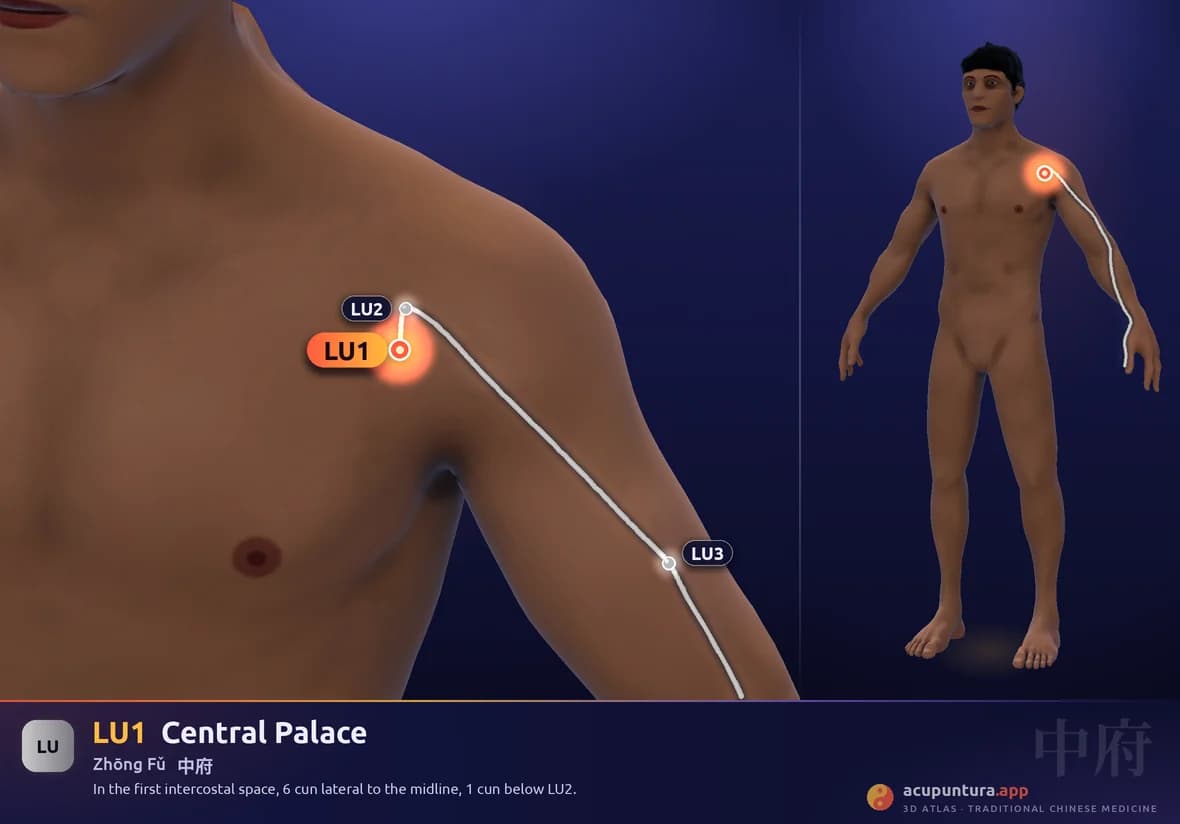
Lung Channel
Central Palace
中府Zhōng FǔAnatomical location
In the first intercostal space, 6 cun lateral to the midline, 1 cun below LU2.
Main function
Regulates Lung Qi, relieves cough and chest pain.
- Lung Front-Mu point
- Crossing point with the Spleen
Therapeutic indications
- Cough
- asthma
- chest pain
- shoulder pain
- dyspnea
- fullness and oppression in the chest
- copious expectoration
- shoulder pain that prevents raising the arm
- spontaneous sweating
- facial edema
- heat and agitation in the chest
- upper back pain
- COPD and chronic bronchitis
Name and classical tradition
Zhongfu, 中府, combines two characters that read straightforwardly: 中, "center" or "interior," and 府, which designates a storehouse, a place where something accumulates. The name presents the point as the central depot of the chest, and its role in the system confirms this: it is the Front-Mu point (募穴) of the Lung, the place on the anterior chest where the Qi of that organ gathers.
The modern interpretive tradition reads this "center" in physiological terms: it would be the Middle Jiao (中焦), whose Qi, born of the Spleen and Stomach, rises to this spot to join the Qi of the Lung. Some reference works even record the line "脾肺合氣于此穴,故曰中府" (Spleen and Lung join their Qi at this point, hence the name Zhongfu), but with no author or work identified, so it is best taken as a school explanation and not as a canonical text.
Among the classics, the oldest reference we have been able to verify describes the location without naming the point. The Lingshu (Spiritual Pivot), in the Wei Qi chapter (衛氣), places the "branch" (標) of the Hand Taiyin at the pulsation on the inner side of the axilla: "標在腋內動也," exactly the area of the point. Two commentators later left their readings. Yang Shangshan, in the seventh century, explains in the Huangdi Neijing Mingtang (Yellow Emperor's Inner Classic, Bright Hall Edition) that the 府 in the name means a place of convergence. Wang Bing, a century later, annotating the Ci Re chapter (刺熱) of the Suwen (Basic Questions), identifies it as a crossing point (交會穴) of the hand and foot Yin channels, the Taiyin of the Lung and that of the Spleen.
The Zhenjiu Jiayi Jing (Systematic Classic of Acupuncture and Moxibustion) defines it precisely: "中府,肺之募也,一名膺中俞," Zhongfu is the Mu point of the Lung, also called Yingzhongshu, "the Shu of the center of the chest," and it also presents it as a meeting point of the Hand Taiyin. Other aliases in circulation, 府中俞 and 膺俞, could not be verified in the text.
Other names
- 膺中俞Jiayi Jing