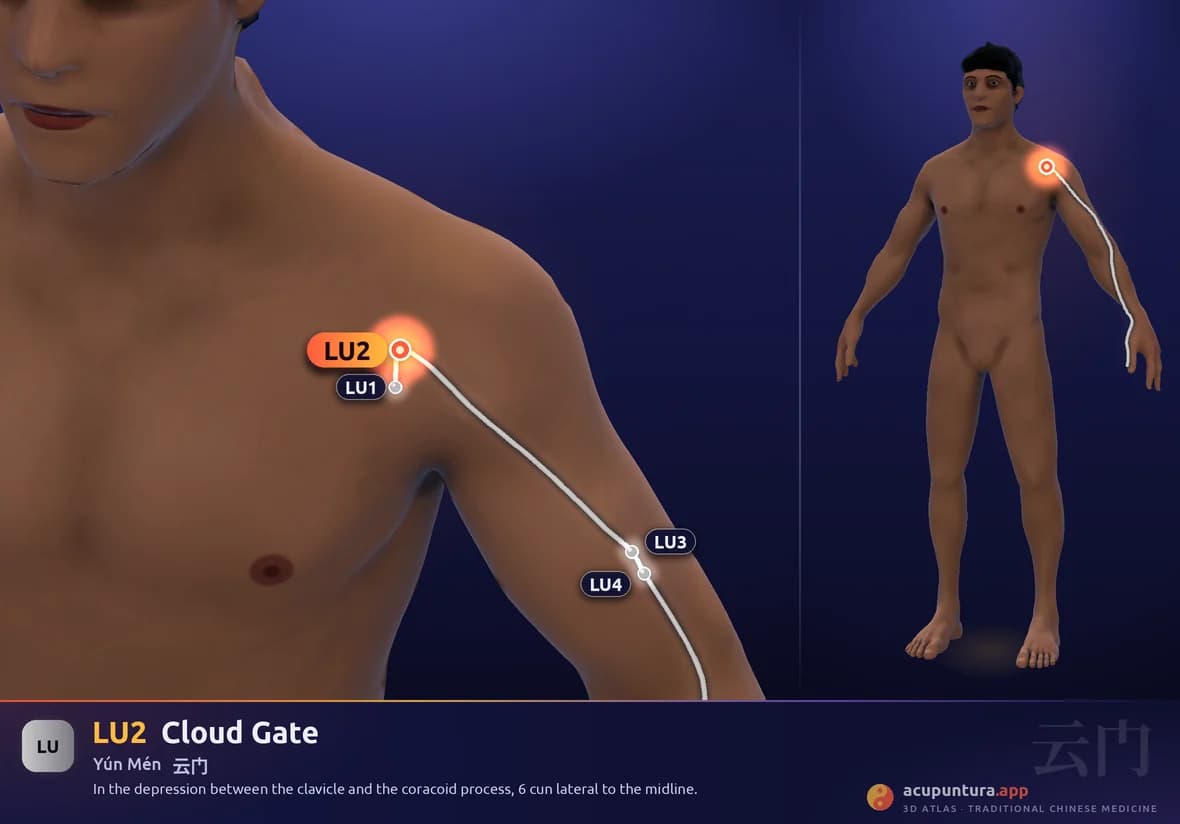
Lung Channel
Cloud Gate
云门Yún MénAnatomical location
In the depression between the clavicle and the coracoid process, 6 cun lateral to the midline.
Main function
Regulates Lung Qi, resolves Phlegm, relieves cough.
Therapeutic indications
- Cough
- asthma
- chest pain
- shoulder pain
- dyspnea
- chest fullness
- inability to raise the arm
- upper back pain
- heat in the chest
- stiffness of the shoulder joint
Name and classical tradition
Yunmen, 云门 in simplified characters and 雲門 in traditional, means "cloud gate." It is the second point of the channel and the first in the Lung's thoracic series to carry a sky name; the third, LU3, follows the same vein. The connection between clouds and the lungs is rooted in the Suwen (Basic Questions): the Yin Yang Ying Xiang Da Lun chapter states that "天氣通於肺," the Qi of heaven communicates with the lung. Reference works complete the idea by noting that clouds are born of that same celestial Qi, "雲出天氣," and the point, high on the chest, is understood as the threshold through which that air enters and leaves the thorax.
The Zhenjiu Jiayi Jing (Systematic Classic of Acupuncture and Moxibustion) by Huangfu Mi gives the location with an almost topographical precision: "在巨骨下,氣戶兩傍各二寸陷者中,動脈應手," below the clavicle, 2 cun to each side of Qihu (ST13), in the depression where a pulse can be felt under the fingers. And it warns: "刺太深令人逆息," if you needle too deeply, the breath is cut off, a prohibition that the book of forbidden points repeats. The name already appears in the Suwen, in the Shui Re Xue Lun chapter (水熱穴論), and Wang Bing, annotating it, describes it as a place where the Qi of the channel emerges. In the Ming period, Wu Kun adds a practical reference in the Zhenfang Liuji (Six Collections of Acupuncture Prescriptions): with the arms hanging at the sides, the point lies at the level of the nipple.
A late work, the Jinnang Milu (Secret Records of the Brocade Bag), from the Ming or Qing period, turns Yunmen into a piece of the complete circulation of Qi and Blood: "人之氣血,周行無間,始于手太陰,出雲門穴,歸足厥陰肝經,入期門穴." The uninterrupted circulation would begin in the Hand Taiyin, exit through Yunmen, and, after traversing the twelve channels, return through the Foot Jueyin to enter LR14. It is not a text from the Han core, but it illustrates well how the later tradition read the name: a gate of exit, the first of a cycle that closes at another gate, 期門.