Spleen Channel
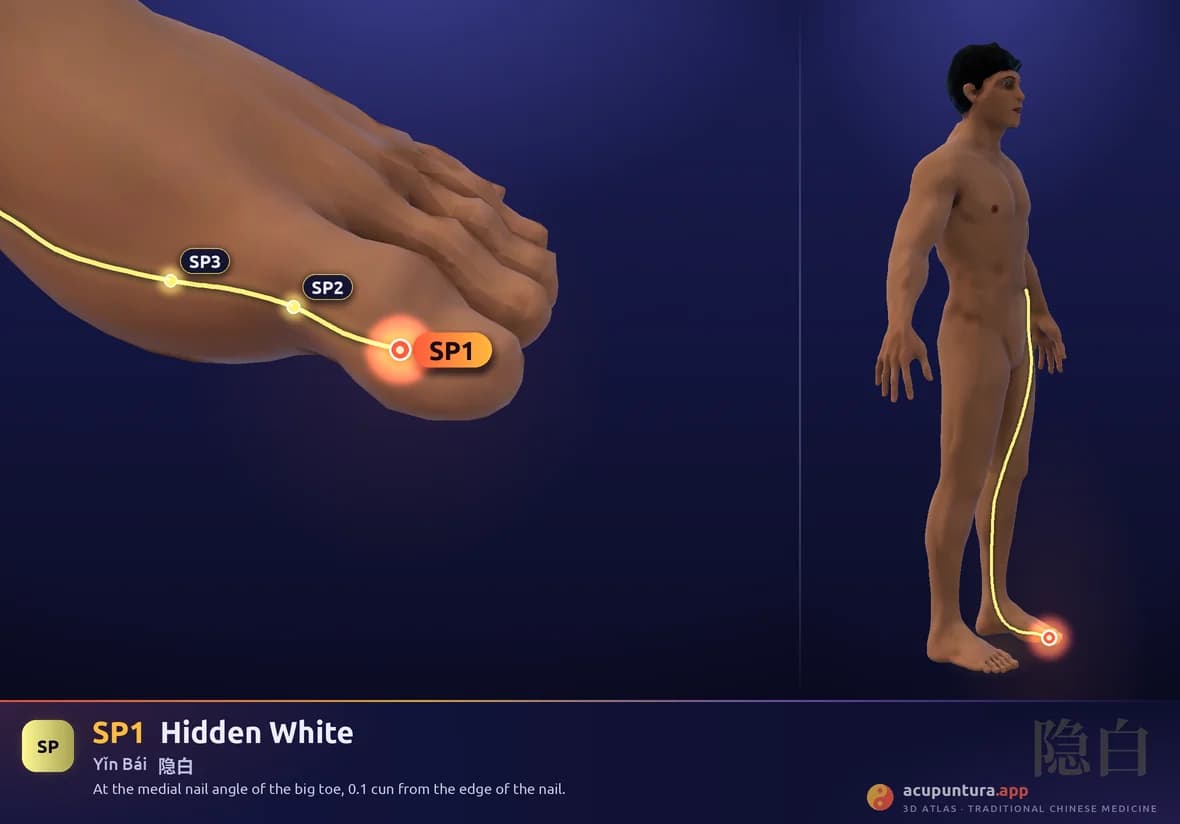
Hidden White
隐白Yǐn BáiUse caution during pregnancy
Powerful hemostatic point; some authors exclude it in pregnancy. Reserve for a clear indication.
Anatomical location
At the medial nail angle of the big toe, 0.1 cun from the edge of the nail.
Main function
Regulates the Blood, calms the Shen, strengthens the Spleen, stabilizes the uterus.
- Jing-Well point (Wood)
- Ghost Point
Therapeutic indications
- Uterine bleeding
- abdominal distension
- insomnia
- diarrhea
- fatigue
- Metrorrhagia
- Menorrhagia
- Epistaxis
- Hematemesis
- Blood in the stool
- Excessive dreaming
- Nightmares
- Infantile convulsions
- Mania
- Schizophrenia (Dian Kuang)
Name and classical tradition
Yinbai (隐白) is the “hidden white.” 隐 (隱) means hidden, tucked away; 白, white, is the color the Five Phases assign to Metal. A modern gloss explains it through the relationship between the phases: Earth, the Spleen, generates Metal, the Lung. At this first point of the channel, Spleen Qi is just beginning to well up, while the Metal that will be born from it remains hidden. It is a clever interpretation, but it has no classical citation.
The Lingshu (Spiritual Pivot), in the Ben Shu (本輸) chapter, opens the channel's sequence with it: “脾出於隱白,隱白者,足大指之端內側也,為井木”. Spleen Qi emerges at Yinbai, on the inner side of the tip of the big toe; it is the Jing-Well point, Wood in nature, like the first point of all the Yin channels.
Its alternate names 鬼壘 and 鬼眼 place it in Sun Simiao's tradition of the thirteen ghost points (十三鬼穴). The Qianjin Yaofang describes the third of them as “足大趾爪甲下,名鬼壘”, beneath the nail of the big toe, called the “rampart of the spirits,” which is the location of Yinbai.