Spleen Channel
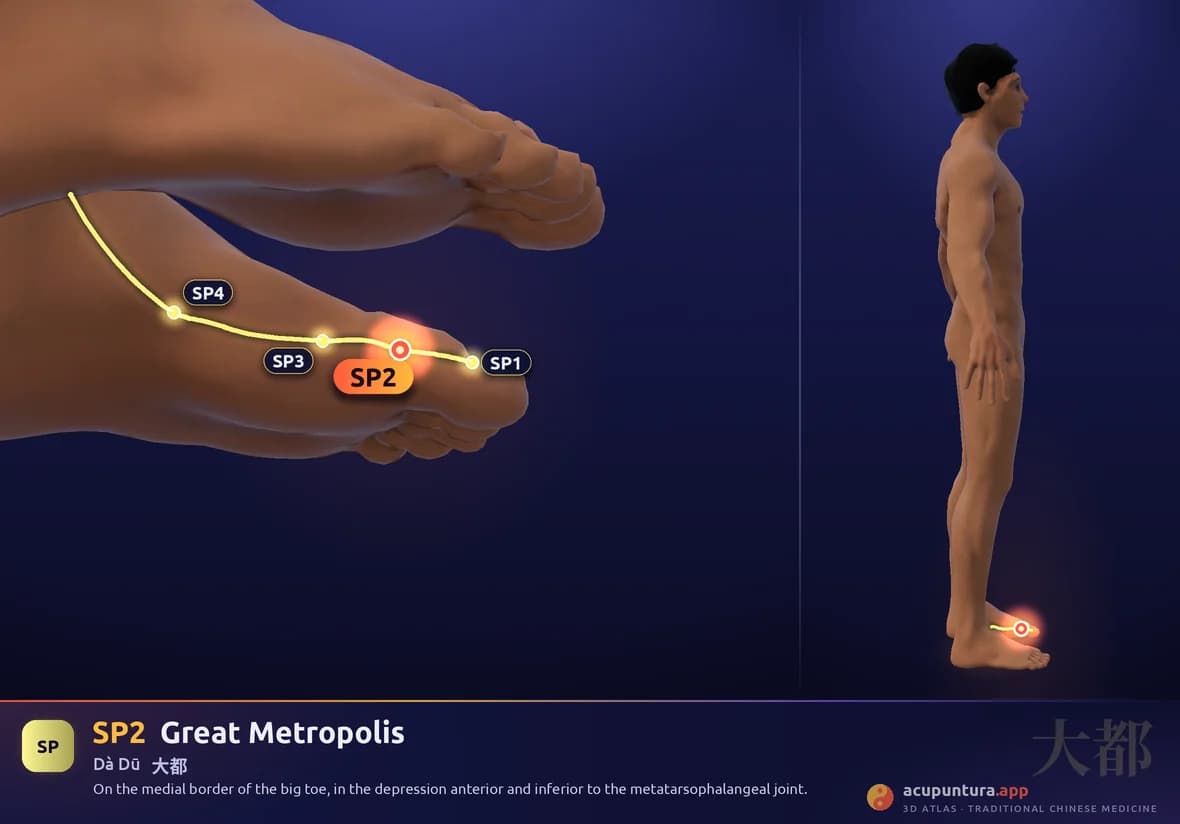
Great Metropolis
大都Dà DūAnatomical location
On the medial border of the big toe, in the depression anterior and inferior to the metatarsophalangeal joint.
Main function
Regulates the Spleen and Stomach, eliminates Damp-Heat, relieves pain.
- Ying-Spring Point (Fire)
- Tonification Point
Therapeutic indications
- Abdominal distension
- diarrhea
- constipation
- pain in the big toe
- Gastric pain
- Vomiting
- Fever without sweating
- Heaviness of the body
- Big toe pain
Ryodoraku
- Tonification of Spleen
Name and classical tradition
Dadu (大都) is the “great capital.” 大 means great; 都, capital, the city where everything gathers. The explanation in modern manuals is that the Qi that wells up at SP1 gathers here as in a great metropolis. It is a reading of the flow of Qi with no classical citation.
The firm evidence is in the Lingshu (Spiritual Pivot), Ben Shu (本輸) chapter: “溜於大都,大都,本節之後,下陷者之中也,為滎”. Qi glides on to Dadu, in the depression behind the joint of the big toe; it is the Ying-Spring point (滎穴), which on the Yin channels corresponds to Fire. Modern compendia record the variant 太都, with 太 in place of 大, a character swap that is common in point nomenclature, with no ancient citation located.