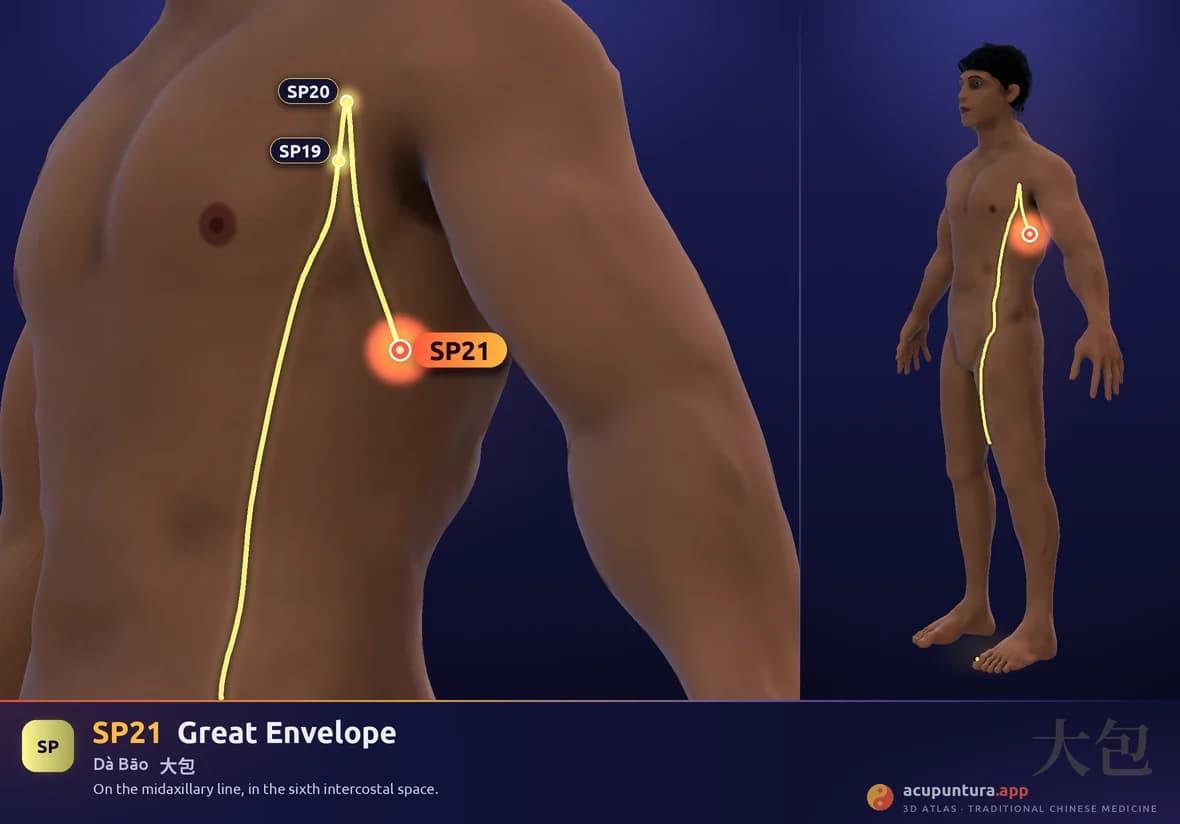
Spleen Channel
Great Envelope
大包Dà BāoAnatomical location
On the midaxillary line, in the sixth intercostal space.
Main function
Regulates Qi and Blood, strengthens the limbs, benefits the Dai Mai.
- Great Luo of the Spleen
- Crossing point with the Dai Mai
Therapeutic indications
- Chest pain
- asthma
- general weakness
- fatigue
- generalized body pain
- weakness of all four limbs
- chest and costal pain
- joint laxity
Name and classical tradition
Dabao, 大包, is the “Great Embracement,” and it is the best-supported point of the whole channel. The Lingshu (Spiritual Pivot), in the chapter Jing Mai (經脈, Channels), presents it this way: “脾之大络,名曰大包,出渊腋下三寸,布胸胁”. The great collateral of the Spleen is called Dabao; it emerges three cun below Yuanye, GB22, and spreads over the chest and the flanks. It is not just any Luo point, but the great Luo (大絡) of the Spleen, which adds to the collaterals of the channels.
The name has been glossed by two commentators. Yang Shangshan, in the seventh century, according to a secondary source: “脾為中土,四臟之主包裹處也,故大包也”. The Spleen is the central Earth, the place that wraps around and governs the other four organs; hence, great embracement. And Zhang Jiebin, in the Leijing Tuyi (Illustrated Supplement to the Classified Classic), in the Ming period: “總統陰陽諸絡,由脾灌溉五臟,臟腑百骸皆受其益,因名大包”. It governs all the collaterals, Yin and Yang; from the Spleen it irrigates the five Zang organs, and the Fu organs and all the bones receive its benefit; hence the name.
The two glosses agree on the essentials: the Spleen, at the center, embraces and nourishes the rest. Both attributions are specific, although the texts should be checked against their editions before being quoted literally.