Spleen Channel
Merchant Hill
商丘Shāng QiūAnatomical location
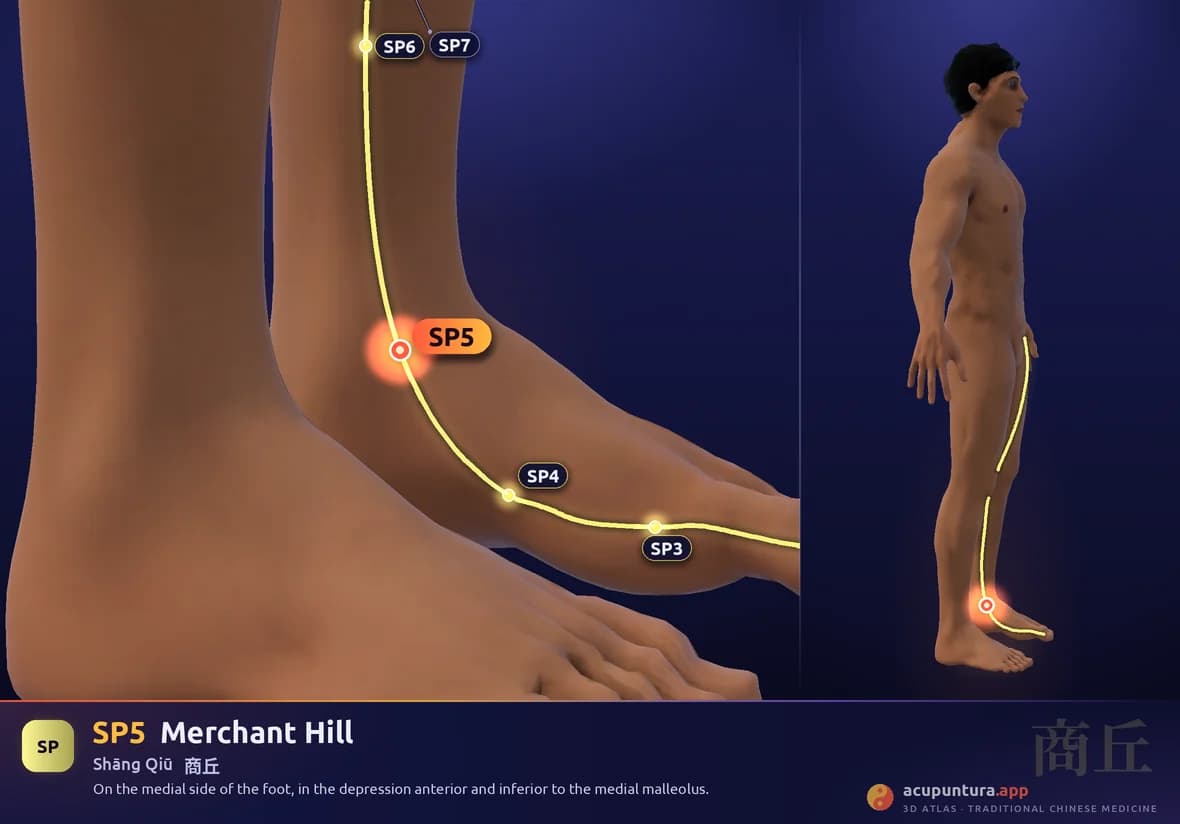
On the medial side of the foot, in the depression anterior and inferior to the medial malleolus.
Main function
Strengthens the Spleen, eliminates Damp-Heat, benefits the joints.
- Jing-River point (Metal)
- Sedation Point
Therapeutic indications
- Abdominal pain
- diarrhea
- jaundice
- ankle pain
- Abdominal distension
- Constipation
- Ankle pain and stiffness
- Heaviness of the body
- Hemorrhoids
- Borborygmi
- Muscle atrophy
- Unprovoked laughter
- Hyperuricemia and gout
Ryodoraku
- Sedation of Spleen
Name and classical tradition
Shangqiu (商丘) combines 商, the musical note associated with Metal in the classical pentatonic scale, and 丘, hill. The soundest reading rests on two facts. The first is anatomical: the point lies in front of and below the medial malleolus, at the foot of that hill of bone. The second is theoretical: Shangqiu is the Jing-River point (經穴) of the channel, and on the Yin channels the Jing-River point corresponds to Metal, as the Nanjing (Classic of Difficulties) establishes in Difficulty 64. The note of Metal beside the hill of the ankle.
A modern gloss also circulates that interprets 商 as the clepsidra (water clock) and 丘 as a wasteland: damp Qi would pass through here quickly, as through the orifice of a water clock, carrying off the Spleen's earth and leaving a barren expanse. It is a gloss with no ancient source.
The Lingshu (Spiritual Pivot), in the Ben Shu (本輸) chapter, defines it this way: “行於商丘,商丘,內踝之下,陷者之中也,為經”. Qi flows through Shangqiu, in the depression below the inner malleolus; it is the Jing-River point. As a curiosity, Shangqiu is also the name of a city in Henan province, the ancient capital of the Shang dynasty, although no source links the city to the point.