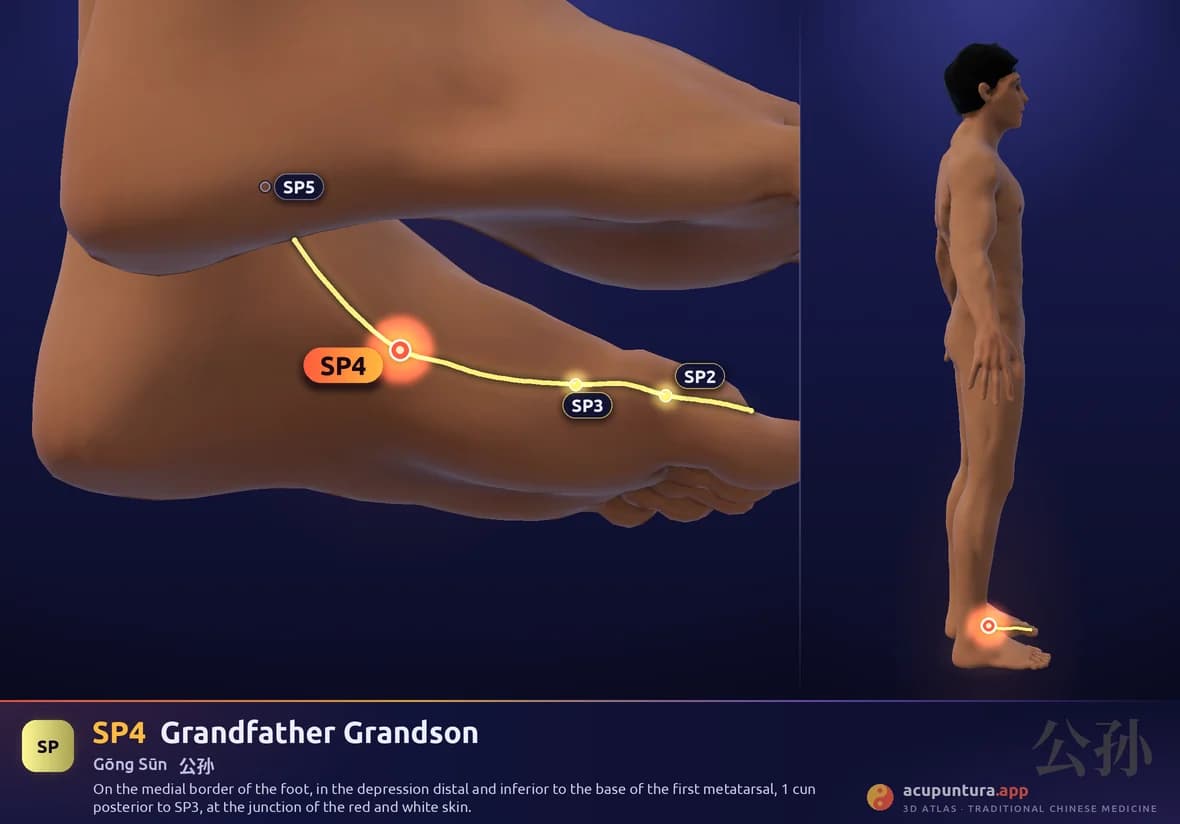
Spleen Channel
Grandfather Grandson
公孙Gōng SūnAnatomical location
On the medial border of the foot, in the depression distal and inferior to the base of the first metatarsal, 1 cun posterior to SP3, at the junction of the red and white skin.
Main function
Harmonizes the Spleen and Stomach, regulates the Chong Mai, relieves pain.
- Luo (Connecting) point
- Opening point of the Chong Mai
Therapeutic indications
- Epigastric pain
- diarrhea
- menstrual disorders
- edema
- Gastric pain
- Vomiting
- Abdominal pain
- Indigestion
- Borborygmi
- Chest pain
- Palpitations
- Irregular menstruation
- Insomnia
Name and classical tradition
Gongsun (公孙) is a lineage name. Gongsun was the family name of the Yellow Emperor, Huangdi, the mythical sovereign who rules from the center with the virtue of Earth. One reading of the point starts there: the Spleen is the Earth of the center, and the point that links it with its paired channel bears the name of the emperor of Earth. Another reading is hierarchical: 公 would be the grandfather, the main channel; 孙 (孫), the grandson, the minor branch that splits off, that is, the collateral. Both circulate in modern sources with no classical citation to support them.
The canonical text comes from the Lingshu (Spiritual Pivot), in the Jing Mai (經脈) chapter rather than the Ben Shu, because Gongsun is not one of the five Shu points: “足太陰之別,名曰公孫。去本節之後一寸,別走陽明;其別者,入絡腸胃”. The collateral of the foot Taiyin is called Gongsun; it lies one cun behind the joint and diverges toward the Yangming; its branch enters and connects with the intestines and stomach. It is the Luo-Connecting point (絡穴) of the Spleen.
Gongsun is also one of the Eight Confluent Points (八脈交會穴), the one that communicates with the Chong Mai. The systematization of those eight points is attributed to Dou Hanqing in the thirteenth century, although the citation has not been verified here. It pairs with PC6, Neiguan, another of those eight points.