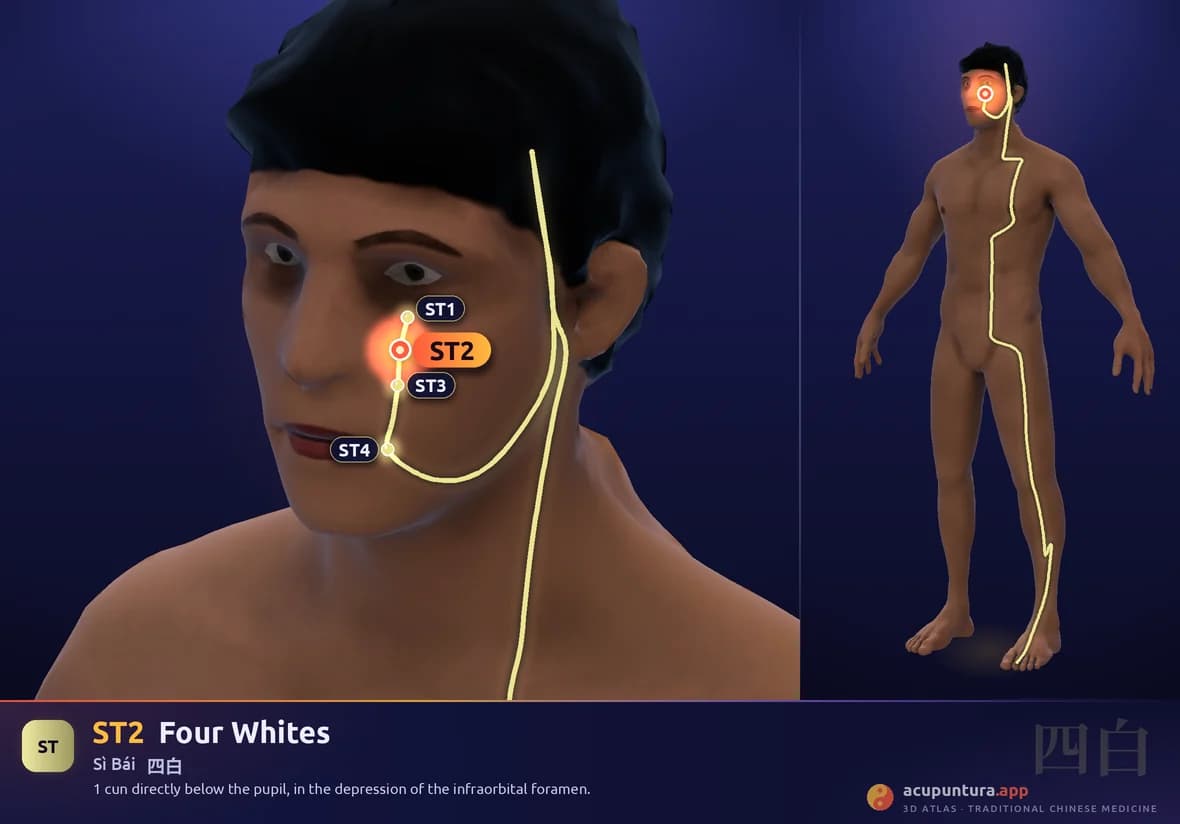
Stomach Channel
Four Whites
四白Sì BáiAnatomical location
1 cun directly below the pupil, in the depression of the infraorbital foramen.
Main function
Disperses Wind-Heat, benefits the eyes, relieves facial pain, unblocks the channel.
Therapeutic indications
- Facial pain
- eyelid spasm
- blurred vision
- rhinitis
- toothache
- facial paralysis
- Eyelid twitching
- Red eyes
- Headache
- Sinusitis
- Trigeminal neuralgia
Name and classical tradition
Sibai, 四白, combines 四, "four" or the four directions, and 白, "white," "clarity." The traditional interpretation understands it as the point that makes you see clearly in all directions, consistent with its location, below the eye, and with its use in disorders of vision. It is a simple reading that claims nothing more.
A modern energetic explanation also circulates, according to which the water of the channel would be rapidly transformed into qi here and rise like a white mist. It is a gloss with no classical commentator to support it.
The first work to record it is the Zhenjiu Jiayi Jing (Systematic Classic of Acupuncture and Moxibustion), although the passage has not been located. No ancient alternative names of its own or specific classical commentaries are known. Like ST1, it is one of the eye points with which the Stomach channel begins its descent across the face.