Stomach Channel
Center of the Nipple
乳中Rǔ ZhōngAnatomical location
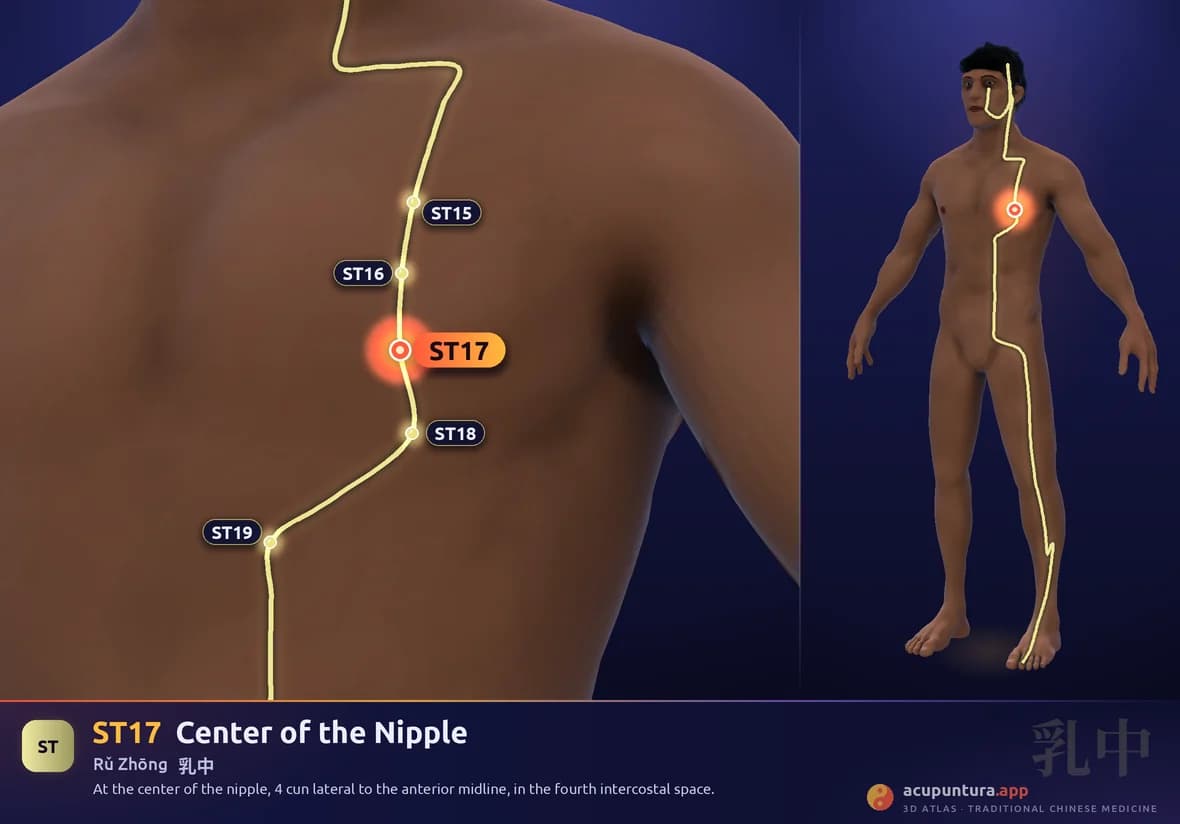
At the center of the nipple, 4 cun lateral to the anterior midline, in the fourth intercostal space.
Main function
Anatomical landmark; not used for needling or moxibustion.
Therapeutic indications
- Not used clinically
- It serves as an anatomical landmark
- Anatomical landmark: not needled and no moxibustion applied
Name and classical tradition
Ruzhong (乳中) is the “center of the breast,” and its name holds no great mystery: it marks the nipple. What is remarkable about this point is not the name but the fact that tradition has always treated it as a point that is not touched. The Zhenjiu Jiayi Jing (Systematic Classic of Acupuncture and Moxibustion) states it without ambiguity: “乳中,禁不可刺灸”. Ruzhong must not be needled or treated with moxa.
The same work explains what happened when the rule was disobeyed: “灸刺之,不幸生蝕瘡,瘡中有膿血清汁者可治,瘡中有息肉若蝕瘡者死”. If the point is needled or moxa is applied, a corrosive ulcer may form. If the ulcer contains pus, blood, or clear fluid, it can be cured; if it contains growing flesh or an ulcer that devours, the patient dies. Few points carry a prohibition this old and this explicit, and it is not a modern convention but a warning from the 3rd century.
The point did serve, however, as a topographic reference. The distance between the two nipples, eight cun, is used to measure other points of the chest and abdomen. The standard references list 乳首 and 當乳, “the head of the breast” and “over the breast,” as descriptive synonyms.